


Most Australian families spend about AUD 800–2,000 a year if they buy everything new, and that first year is the priciest because babies race through sizes so fast. Switch to a hybrid secondhand-plus-new approach and that figure typically drops to around AUD 300–600. The smartest split is simple: buy secondhand for anything your baby will outgrow in weeks, and buy new for shoes and safety-rated sleep items.
TL;DR:
- Buying secondhand for sizes worn for only a few weeks can reduce costs to less than AUD 7 per week, compared to over AUD 30 for new items.
- Focus on purchasing new safety-rated sleepwear, shoes, and snug-fitting items, while sourcing everyday basics secondhand through online marketplaces and thrift stores.
- Shop for seasonal clothing during end-of-season sales to maximize savings and combine cashback offers with markdowns for additional discounts.
- Limit early sizes to a small wardrobe of one or two weeks’ worth, and build a hybrid wardrobe from secondhand for high-turnover sizes and new for safety essentials.
- A typical first-year clothing budget ranges from AUD 500–1,000 for most families, with the hybrid approach averaging around AUD 300–600, depending on your patience and connections.
Table of Contents
- How much do baby clothes cost by size in Australia?
- How can Australian parents save money on baby clothes?
- What baby clothes should you buy new vs secondhand?
- What’s a realistic baby clothing budget for year one?
- What I think about premium organic pieces in a budget-conscious wardrobe
- Where quality basics fit your hybrid wardrobe
- Sources
- FAQ
How much do baby clothes cost by size in Australia?
The reason baby clothes cost so much in the first year isn’t the price per item. It’s how often you’re buying. A newborn can move through three or four sizes before their first birthday, and each jump means another mini wardrobe.
Here’s roughly how long each size lasts and general relative costs new versus secondhand:
- Size 000 (up to 3–4kg): Often worn for just 4–8 weeks, sometimes skipped entirely if your baby arrives on the larger side. New basics run AUD 15–30 per piece; secondhand bundles for this size can be found for as little as AUD 20–50 for a whole bundle, versus AUD 150–300 if you bought the same pieces new.
- Size 00 (3–6 months): Lasts around 2–3 months. Budget AUD 15–35 per new item, or AUD 25–60 for a secondhand bundle covering several outfits.
- Size 0 (6–9 months): Similar wear window, similar pricing, though this is when babies start crawling and knees wear out faster.
- Size 1 (12 months): Toddlerhood pricing kicks in here. New pieces edge up to AUD 20–40, reflecting sturdier fabrics and more design detail.
- Sizes 2–3 (toddler): Clothes last longer per size (4–6 months), so cost per week actually drops even though individual items cost more.
- Sizes 3–5 and school age: Wear time stretches to 6–12 months per size, and quality starts to matter more than quantity because these clothes take a beating.
Do the maths on cost-per-week and secondhand wins by a wide margin in the newborn sizes. A AUD 200 all-new size 000 wardrobe worn for six weeks costs roughly AUD 33 a week. The same wardrobe sourced secondhand for AUD 40 costs less than AUD 7 a week. That gap narrows as sizes last longer, which is exactly why a hybrid strategy makes the most sense early and gets more flexible as your child grows.
How can Australian parents save money on baby clothes?
Saving on baby clothes isn’t about being tight with money. It’s about spending where it counts and skipping where it doesn’t. Here’s a practical order of operations:
- Sort newborn sizes first, and go light. Buy or borrow no more than a week or two’s worth of size 000 before birth. You genuinely don’t know how big your baby will be, and bulk-buying this size is the single most common way families waste money.
- Build your secondhand pipeline early. Curated preloved baby stores, Facebook Marketplace groups, local op shops, and neighbourhood clothing swaps are all reliable, low-cost sources for high-turnover sizes.
- Reserve new purchases for safety items. Sleep bags with safety ratings and properly fitted shoes should always be bought new.
- Time your seasonal buys. Shop for winter woollens in March and summer basics in September, right before the big end-of-season clearances, so you’re catching sale stock a season ahead rather than paying full price when you actually need it.
- Stack cashback with sales. Apps and portals like ShopBack offer cashback of roughly 3–10% on baby clothing purchases, and that stacks neatly on top of end-of-season markdowns.
Pro Tip: Set a calendar reminder two weeks before each seasonal changeover. Retailers mark down current-season stock right as the new range lands, which is the exact window to grab next year’s size at half the price.
What baby clothes should you buy new vs secondhand?
Not every purchase is a place to cut corners, but plenty are. The rule of thumb: buy new when safety or fit is non-negotiable, and buy secondhand when the item is high-turnover and low-risk.
Buy new:
- Safety-rated sleepwear and sleep bags
- Shoes, once your baby is walking (fit matters for developing feet)
- Anything where a snug, specific fit affects safety or function
Fine to buy secondhand:
- Bodysuits, onesies, and singlets
- Everyday tops, pants, and leggings
- Occasion wear worn once or twice
- Bibs, hats, and mittens
When you’re shopping secondhand, run a quick three-point check before you buy: hold the fabric up to the light for thinning or holes, check seams and poppers haven’t warped from washing, and read the label to confirm the fabric type matches what you’re expecting. Our fabric guide breaks down how different materials wear over time, which is worth a read before you commit to a big secondhand haul.
What’s a realistic baby clothing budget for year one?
Three scenarios cover most families:
- All-new: AUD 800–2,000 for the year, reflecting full retail prices across four size changes plus first-year estimates around AUD 500–1,000 just for clothing once you factor in extras like outerwear and occasion pieces.
- Hybrid (recommended): AUD 300–600 for the year, mixing secondhand basics with new shoes and sleepwear.
- All-secondhand: Can drop below AUD 300 if you’re patient and connected to good swap networks, though shoes and safety sleepwear should still be bought new regardless of the strategy.
A sample AUD 400 hybrid split might look like this: AUD 100 on a secondhand bundle haul across two sizes, AUD 80 on one new safety-rated sleep bag, AUD 60 on new shoes once walking starts, AUD 100 on new basics caught in seasonal sales, and AUD 60 held back for swaps or gap-filling as sizes shift.
What I think about premium organic pieces in a budget-conscious wardrobe
One thing hasn’t changed in baby clothing: durability changes the maths. A premium organic bodysuit that survives four wash cycles a week for six months and gets handed down again isn’t the same purchase as a cheap version that pills after a fortnight. Cost-per-wear is the number that actually matters, not the sticker price.
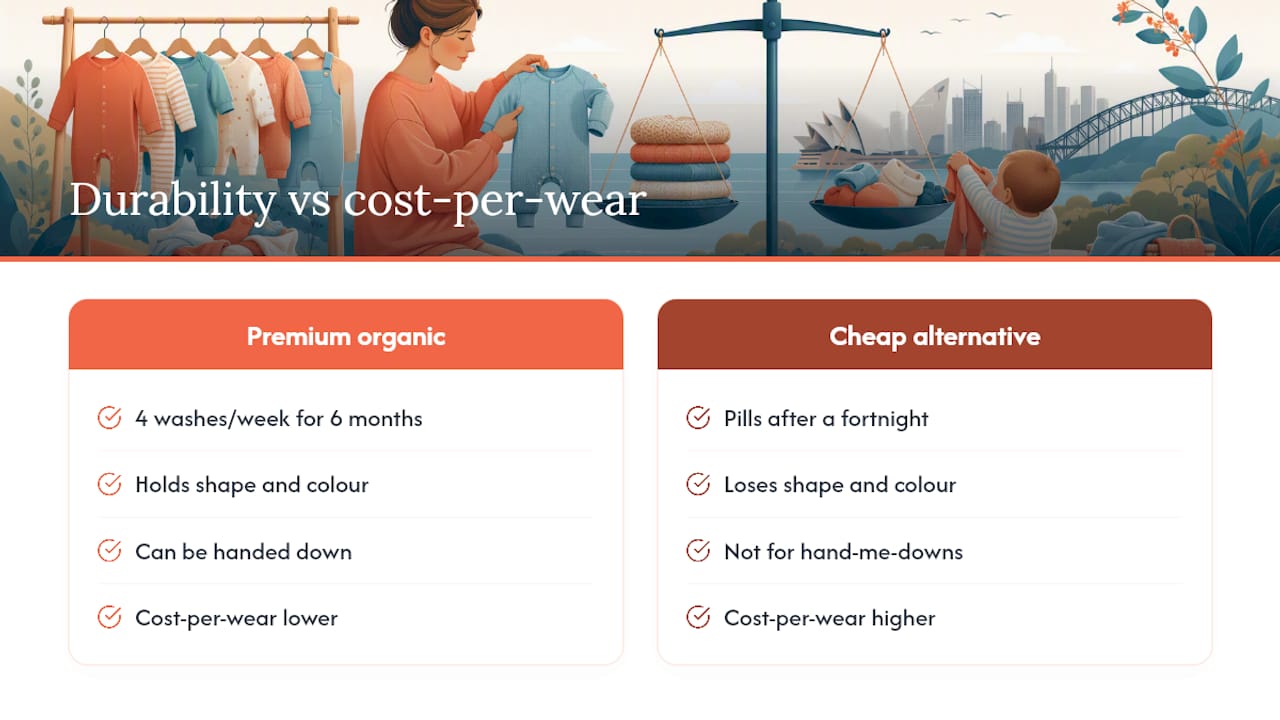
Our fabric guide walks through why certain organic cottons hold their shape and colour longer. We ship for a flat $7.95 across Australia (free over $97)), and every order comes with 30-day easy returns, so testing a quality piece against your budget carries no risk.
— Daniel
Where quality basics fit your hybrid wardrobe
Premium organic basics represent the part of your wardrobe where durability actually earns its keep. Our Frugi Fun Flowers Bodysuits (2-Pack) are the kind of everyday basic that takes daily wear and repeated washing without pilling, which matters when a bodysuit gets worn two or three times a week.
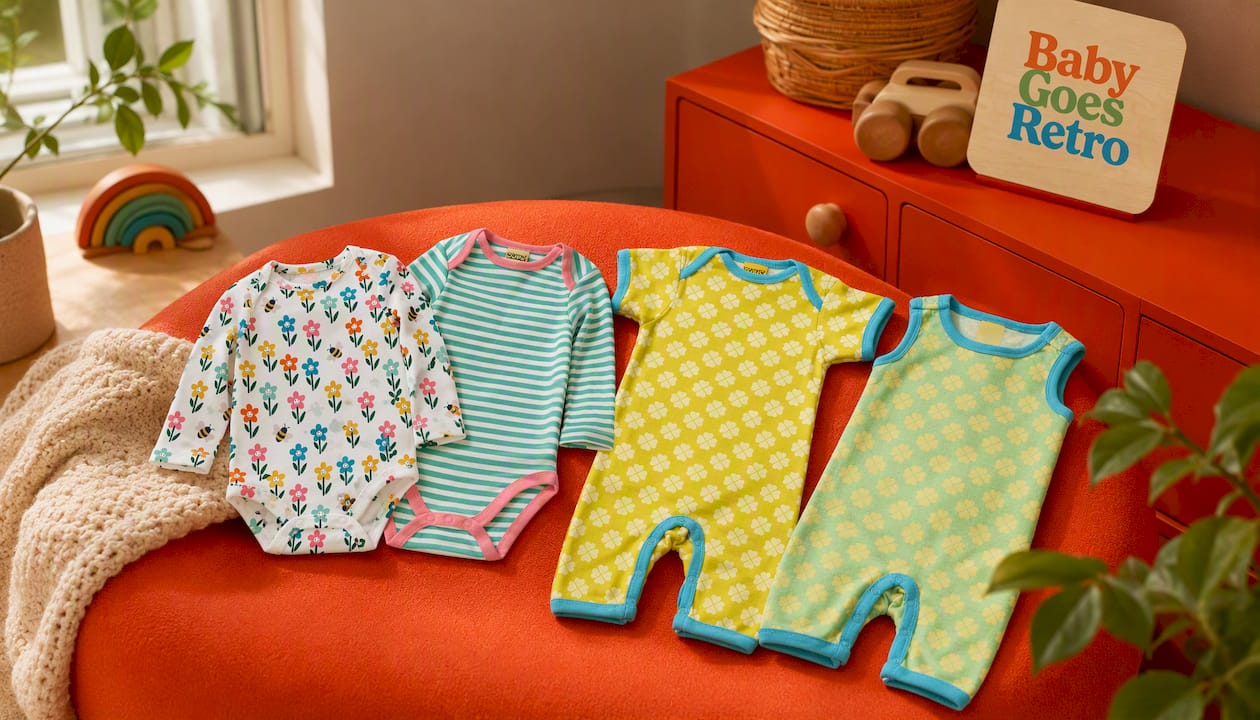
For daywear that earns its cost-per-wear, the DUNS Sweden Clover Playsuit in Sulphur Green and the DUNS Sweden Clover Playsuit in Green Ash are both built from durable organic cotton with reinforced taping at the seams, the kind of construction that holds up through a toddler’s crawling and climbing phase rather than fraying after a season. Bright, colourful, and made to be handed down.
Browse the full baby clothing collection to build out your hybrid wardrobe around a few durable new pieces. Australian shipping is a flat $7.95, free over $97, and every order carries 30-day easy returns and exchanges if the fit isn’t right.
FAQ
What is the average cost of baby clothes in Australia?
Families buying all new typically spend AUD 800–2,000 a year, while a hybrid secondhand-and-new approach usually brings that down to AUD 300–600.
How much should I budget for baby clothes in the first year?
First-year clothing costs alone are commonly estimated at AUD 500–1,000, reflecting the four or so size changes a baby goes through before their first birthday.
How much are individual baby clothing items in Australia?
New basics like bodysuits and singlets generally cost AUD 15–35 per piece, while secondhand bundles covering multiple items in one size can be found for AUD 20–60.
Is buying secondhand baby clothes actually worth it?
Yes, particularly for newborn and early sizes that get worn for only a few weeks. Secondhand bundles for size 000 can cost a fraction of new prices, while safety items like sleep bags and shoes are worth buying new regardless of size.
Why do baby clothes cost so much in the first year specifically?
It comes down to turnover, not price per item. A baby moves through three or four sizes in twelve months, so the “cost” is really the cost of buying a new wardrobe every couple of months rather than any single item being expensive.
0 comments