


Read the label’s five categories in order: wash, bleach, dry, iron, professional care. Numbers inside symbols mean maximum temperature in degrees Celsius, bars underneath mean gentler mechanical action, dots mean heat level, and any symbol with a cross through it means “do not.” That’s this clothing care labels guide in a single breath.
A practical rule that gets you through most laundry decisions is to always follow the mildest, safest method the label allows, and when two symbols seem to disagree, defer to whichever one protects the fabric more; for detailed care guidance, see how to wash period underwear and make it last at SweeTee Beauty. Everything past this paragraph just fills in the detail behind that rule.
Three sources back every symbol explained in this guide:
- ISO 3758 — the international standard that defines the symbols themselves
- AS/NZS 1957:1998 — the Australian and New Zealand voluntary standard for what a label should contain
- The ACCC — Australia’s regulator whose mandatory care labelling standard makes proper labelling a legal requirement, not a courtesy
Key Takeaways
Mastering five symbol categories, wash, bleach, dry, iron, and professional care, is enough to correctly handle almost any garment you own.
| Point | Details |
|---|---|
| Numbers mean maximum, not target | A “30” in the wash tub is the ceiling temperature in °C; washing cooler is always safe. |
| Bars measure gentleness | No bar is normal, one bar is mild, two bars is very delicate; more bars means less agitation. |
| Crosses always mean “don’t” | A crossed symbol, whether on the tub, iron or triangle, is a hard stop for that action. |
| Follow the most delicate component | On multi-fabric garments, the trim or lining with the strictest instruction sets the rule for the whole piece. |
| Choose organic, well-labelled garments | Baby Goes Retro’s organic children’s clothing carries clear care instructions and ships flat-rate for $7.95, free over $97, with 30-day returns. |
Table of Contents
- Understanding clothing labels: what governs the symbols you see
- The Big Five care symbols, decoded properly
- Reading written phrases and multi-part labels
- What to do when a label is missing, damaged or seems too cautious
- Caring for baby and kids’ clothing: what’s different
- Your laundry-room cheat sheet
- A note from the label side of things
- Why Baby Goes Retro makes garment care easier from the start
- Sources
- FAQ
Understanding clothing labels: what governs the symbols you see
Care labels aren’t decoration. They’re a compressed set of instructions, and in Australia, they’re legally mandated. Manufacturers can meet that requirement with plain English words, the five internationally recognised pictograms, or a mix of both, provided the instructions are adequate, legible and properly attached.
Three standards sit behind every tag you’ve ever squinted at:
- ISO 3758 sets the actual design and meaning of each symbol, so a washtub icon means the same thing on a garment made in Portugal as one made in Vietnam.
- AS/NZS 1957:1998 is the local standard guiding what information a permanent care label needs to include and how a garment gets classified for labelling purposes.
- The Consumer Goods (Care Labelling) Information Standard, enforced by the ACCC, makes this mandatory for clothing, bedding, and textile furnishings sold in Australia. Get it wrong as a supplier, and you’re looking at fines or a recall.
Care labels are technical instructions meant to prevent damage. They’re not a marketing flourish, and treating them as optional is how good garments end up ruined in a single wash cycle.
If a label is missing, damaged, or looks suspiciously cautious, don’t panic. There’s a safe way to work around it, covered further down.
The Big Five care symbols, decoded properly
Every care label boils down to five symbol families. Master these and you can read almost any garment tag with confidence.
Washing (the tub). The number inside the tub is the maximum washing temperature in °C, not a suggestion or an average. A tub showing “30” means don’t exceed 30°C, though washing colder is always fine. Bars underneath the tub tell you how rough the machine should be: no bar means a normal cycle, one bar means a mild cycle, and two bars means a very gentle, delicate cycle for fragile fibres. A hand icon inside the tub means hand wash only, and a crossed-out tub means don’t wash at all, usually reserved for garments needing professional care instead.
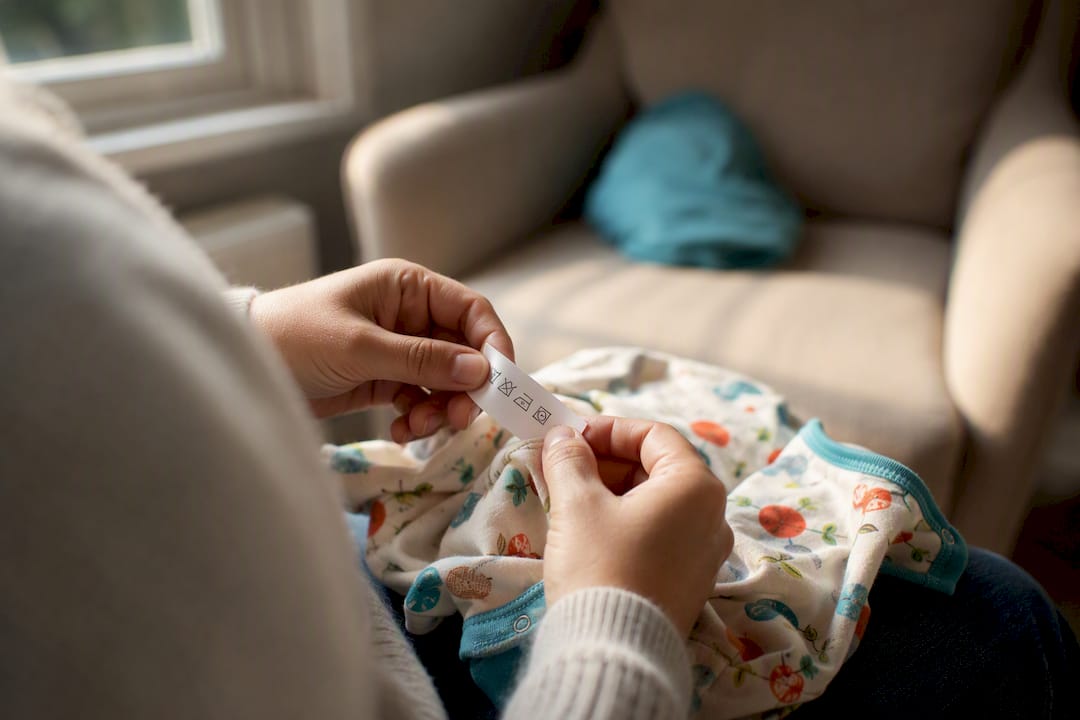
Bleaching (the triangle). An empty triangle allows any bleach. A triangle with two diagonal lines inside means oxygen bleach only, no chlorine. A crossed triangle means skip bleach entirely.
Drying (the square). A square with a circle inside represents tumble drying, and dots inside that circle work the same way as ironing dots: one dot for low heat, two for medium, three for high. No tumble-dry symbol at all, or a crossed version, means you need to air-dry. Lines inside a plain square indicate how: a vertical line means hang to dry, a horizontal line means dry flat, and diagonal lines in the corner mean dry in the shade, common on brightly dyed or organic-dyed pieces that fade in direct sun.
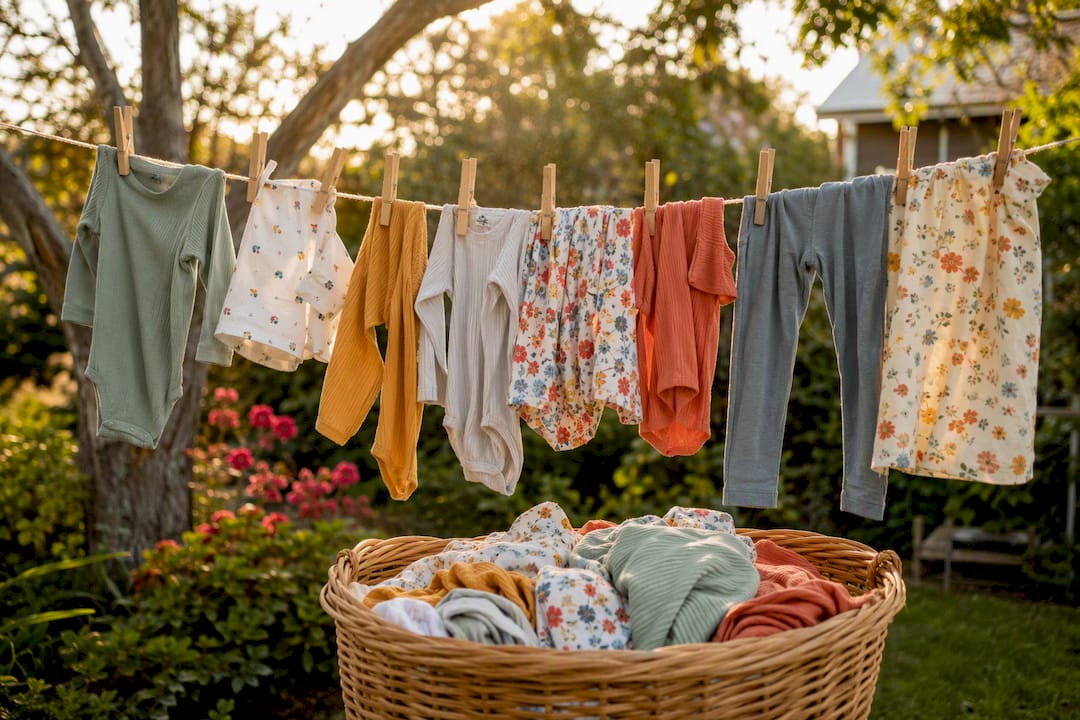
Ironing (the iron icon). Dots inside the iron icon set the temperature band. One dot is a cool iron for synthetics, two dots is medium for wool and blends, and three dots is hot, generally safe for cotton and linen. A crossed iron means don’t iron at all, full stop, often seen on garments with heat-sensitive prints or trims.
Professional care (the circle). A plain circle means dry-clean using any solvent. Letters inside change the meaning: “A” allows any solvent, “P” restricts it to specific solvents, and “F” is now rare. A circle with a bar underneath limits the intensity of the process, mirroring the bars under the wash tub. A circle with a “W” inside indicates professional wet-cleaning, a gentler machine process some dry cleaners offer as an alternative to solvent cleaning.
| Symbol | What it means | Quick home action |
|---|---|---|
| Tub with “30” and 1 bar | Max 30°C, mild cycle | Cold to warm wash, gentle cycle |
| Tub with hand icon | Hand wash only | No machine, wash by hand in cool water |
| Crossed tub | Do not wash | Send for professional cleaning |
| Empty triangle | Any bleach permitted | Chlorine or oxygen bleach both fine |
| Crossed triangle | No bleach | Skip bleach products entirely |
| Square with 1 iron dot | Cool iron only | Lowest heat setting, no steam if unsure |
| Crossed iron | Do not iron | Steam gently from a distance if needed |
| Circle with “P” | Dry-clean, specific solvents | Take to a professional cleaner |
Pro Tip: When a label gives you a maximum temperature and a mild-cycle bar, you’re allowed to go milder still. GINETEX’s own guidance confirms the symbol marks the most severe treatment a fabric can safely handle, not the ideal one, so when you’re torn between stain removal and fabric protection, choose the gentler, cooler option every time.
Reading written phrases and multi-part labels
Plenty of labels skip pictograms entirely and just use words, so knowing the shorthand matters. “Cool iron” means the lowest heat setting. “Do not tumble dry” means air-dry only, no exceptions. “Dry flat” means lay the garment on a towel rather than hanging it, which stops knitwear stretching out of shape.
Trickier are garments with multiple components, a knitted jumper with a woven leather patch, or a dungaree with a printed panel. When instructions differ between parts, always follow whichever is more delicate. If a wash symbol allows 40°C but a printed motif elsewhere on the tag says cool iron only, the print is your limiting factor for heat generally, not just for ironing.
A combined label reading “30°C, 1 bar, tumble dry crossed, 1 iron dot” translates to: cool gentle wash, air-dry only, iron on the lowest setting. Read the whole label as one instruction, not four separate ones.
What to do when a label is missing, damaged or seems too cautious
Unreadable tag? Faded symbol? Here’s a safe sequence to follow rather than guessing:
- Check the fabric composition if it’s still listed, even without care symbols. Natural fibres like cotton and wool behave very differently to synthetics under heat.
- Patch-test in an inconspicuous spot, like an inside seam, with a damp cloth and a small amount of your usual detergent.
- Start with the mildest method available: hand wash or a cold, gentle machine cycle, low spin.
- Air-dry rather than tumble-dry unless you’re confident the fabric can take heat.
- Escalate to a professional cleaner if the fabric shows any sign of colour transfer, texture change, or shrinkage during your test.
Worth knowing: a blanket “dry-clean only” label doesn’t always mean the fabric will fall apart in water. The ACCC’s own review of the care labelling standard notes that manufacturers sometimes choose conservative instructions out of caution rather than genuine material necessity. That’s not licence to ignore the label, but it does mean a careful, small-scale test is worth trying before you write the garment off or pay for dry-cleaning every single time.
Pro Tip: Before washing any coloured garment for the first time, rub a damp white cloth firmly against a hidden seam. If colour transfers onto the cloth, wash that item separately in cold water from now on.
Caring for baby and kids’ clothing: what’s different
Baby and kids’ clothing needs a gentler hand than adult wear, partly because the fabrics are often finer and partly because little bodies react to what touches their skin. A few rules worth locking in:
- Wash at lower temperatures than the label’s maximum where possible, particularly for organic cotton, which tends to soften rather than degrade over repeated cool washes.
- Skip fabric softener on organic knits, since it coats fibres and can reduce breathability over time.
- Do up poppers and zips before washing to stop them snagging on other garments or stretching out the fabric around the fastenings.
For stains, pre-treat gently rather than reaching for hot water and hoping. Cold-water spot cleaning with a small amount of detergent, worked in with your fingers, handles most food and mess without pushing past what the label allows.
Take the Kite Pig Pannage Long Sleeve Bodysuit as a practical example: cotton bodysuits with popper openings typically carry a cool machine wash and low tumble-dry allowance, so doing up the poppers first protects both the fabric and the fastenings. A bundle like the Kite Koala Time Baby Gift Bundle often mixes garment types in one gift set, which means checking each label individually rather than assuming they all match. And for something like the Kite Pear-fect Dungaree Toddler Bundle, the buckles and straps are usually the limiting factor for both wash temperature and drying method, not the fabric itself. For more on stain routines specific to little ones, Baby Goes Retro’s guide on washing baby clothes stains covers the detail.
Your laundry-room cheat sheet
Pin this near the machine and you’ll rarely need to think twice:
- If in doubt: cold gentle wash → low spin → air-dry in shade.
- Crossed symbol = don’t do that thing, full stop.
- Numbers = maximum, never a target.
- Dots and bars = the fewer, the gentler.
| Situation | One-line action |
|---|---|
| Fresh stain, unsure of fabric | Cold spot-clean, don’t rub hard |
| No tumble-dry symbol shown | Air-dry only |
| Bright or dark colours, first wash | Wash separately in cold water |
| Delicate trims or prints | Turn garment inside out before washing |
Keep removable care tickets in a drawer rather than binning them, especially for special-occasion or heirloom pieces. A small handwritten note pinned inside a keepsake garment saves guesswork years down the track.
A note from the label side of things
At Baby Goes Retro, we’ve been sourcing organic children’s clothing since 2007, and care instructions get real attention before a garment ever reaches you. We test fabrics and favour the least demanding safe method a garment can handle, because durable, colourful clothes only stay that way if the care advice is right. Got a specific stain or fabric question? Our blog has more detail, or reach out to our team directly.
Why Baby Goes Retro makes garment care easier from the start
Reading a care label correctly is only half the job. The other half is buying clothes where the label is worth trusting in the first place, and that’s where a family-run specialist beats a fast-fashion rack every time. Baby Goes Retro has spent since 2007 curating organic European brands chosen specifically for how well they hold up to real childhood, not just how they photograph.
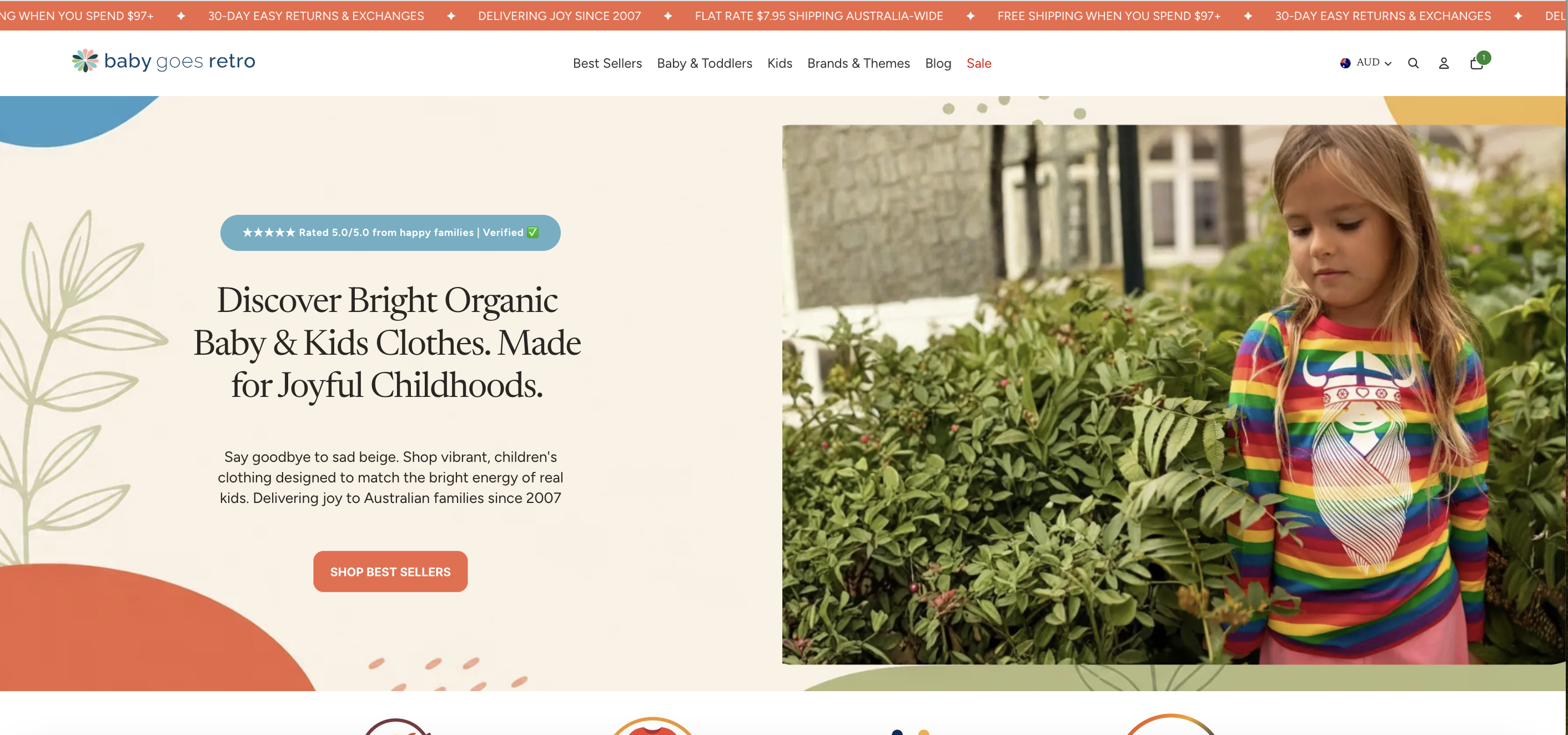
Every piece on the site, from the Kite Pig Pannage Bodysuit to the DUNS Sweden Clover Dungarees, comes from brands that build garments to survive washing machines, siblings, and everything in between. If you’re stocking up for a newborn or a growing toddler, browse the full range at Baby Goes Retro, with flat $7.95 shipping Australia-wide, free once your order hits $97, and 30-day easy returns if anything doesn’t feel right once it arrives.
Sources
For deeper reading beyond this guide, these are the primary references worth bookmarking:
- Care labelling for clothing and textiles mandatory standard | ACCC Product Safety
- GINETEX — Existing care symbols under ISO 3758:2023
- Clothes washing symbols explained — Choice
Note that GINETEX’s five care symbols are trademarked, so manufacturers need proper licensing to use them. If you spot a label on sale in Australia that looks incomplete or non-compliant, the ACCC’s Product Safety site accepts reports directly.
FAQ
What are the five basic care labels?
The five categories are washing (tub), bleaching (triangle), drying (square), ironing (iron icon), and professional care (circle). Every care label you’ll encounter is built from combinations of these five symbol families.
What are the care label requirements for clothing sold in Australia?
Suppliers must provide care instructions that are adequate, legible, and permanently attached where required, under the Consumer Goods (Care Labelling) Information Standard enforced by the ACCC. This applies to clothing, bedding, and many other textile products.
What do the different symbols on clothing labels actually mean?
Numbers show maximum temperature, bars show how gentle the cycle should be, dots show heat intensity for ironing or drying, and any crossed-out symbol means don’t do that action at all.
How do I read a care label if it has no words, only symbols?
Work through the symbols left to right: wash tub first for temperature and cycle, then bleach, dry, iron, and professional care. Follow the most restrictive symbol on the label, and when components differ, defer to the most delicate one.
Does Baby Goes Retro’s clothing come with clear care labels?
Yes, Baby Goes Retro’s organic children’s clothing is labelled with standard care instructions so parents can wash, dry and iron with confidence from the first use.
0 comments