


Dress your baby in fitted layers of natural fibre, keep the head uncovered, and use a TOG-rated sleeping bag instead of loose blankets. That single rule covers the vast majority of Australian nights and aligns directly with Red Nose Australia’s safe-sleep guidance.
Quick checklist for tonight:
- Fitted bodysuit or singlet as a base layer
- Light layer on top if the room is cool (e.g. a long-sleeve romper or footed suit)
- TOG-appropriate sleeping bag with a snug neck and armholes
- No hat, hood, or beanie at sleep time
- Hands and feet may feel cool — that is normal
Overheating is associated with increased risk of Sudden Unexpected Death in Infancy (SUDI), so the goal is comfortably warm, never hot.
Key takeaways
Fitted natural-fibre layers, a TOG-appropriate sleeping bag, and a chest-or-back warmth check are the three things that matter most when dressing your baby for sleep in Australia.
| Point | Details |
|---|---|
| Head always uncovered | Never use a hat or hood at sleep time — the head is how babies release heat. |
| TOG range 0.2–3.5 | Match the sleeping bag TOG to your room’s overnight temperature using the outfit guide above. |
| Check chest or back | Hands and feet are unreliable; the chest or back tells you whether the core is warm and dry. |
| Stop swaddling at rolling | Once your baby shows signs of rolling (around 3–4 months), switch to a fitted sleeping bag. |
| Baby Goes Retro sleepwear | Organic cotton playsuits and bodysuits from Baby Goes Retro are fitted, breathable, and suited to Australian safe-sleep guidance. |
Table of Contents
- Why does dressing correctly for sleep matter?
- How do room temperature and TOG ratings work together?
- What should your baby wear tonight? A quick outfit guide
- How to swaddle safely and when to stop
- Which fabrics and layering strategy work best in Australia?
- How can you tell if your baby is too hot or too cold?
- What does a safe cot setup look like?
- Seasonal tips for Australian homes — summer, winter and everything in between
- How this guide was created
- A note on balancing safety and product choices
- Organic sleepwear that matches safe-sleep guidance
- Sources
- FAQ
Why does dressing correctly for sleep matter?
Overheating is one of the modifiable risk factors linked to SUDI, which is why Australian health authorities consistently prioritise keeping babies comfortably warm rather than maximally warm. Red Nose Australia and Pregnancy, Birth and Baby both emphasise the same core principles: baby sleeps on their back, head and face remain uncovered, and no loose bedding sits in the cot.
Red Nose Australia advises: dress your baby comfortably for the room — not too hot, not too cold — keep the head and face uncovered, and check warmth by feeling the chest or back, not the hands or feet.
The hands-and-feet check is a common parenting instinct, but it is unreliable. Babies’ peripheral circulation is still developing, so cool hands and feet are normal even when the core is perfectly warm. Feeling the chest or back gives you an accurate read in seconds.
How do room temperature and TOG ratings work together?
TOG stands for Thermal Overall Grade, a standard measure of a fabric’s insulating capacity. In Australia, infant sleeping bags typically range from 0.2 to 3.5 TOG: lower ratings suit warm nights, higher ratings suit cooler ones.
One thing worth knowing: Red Nose does not recommend a single ideal room temperature. Instead, the guidance is to dress your baby as you would dress yourself for the same room, then check the core. Manufacturers’ TOG charts are a useful starting point, not a hard rule — room temperatures shift overnight, and every home is different.
| Room temperature | Suggested TOG | Typical underlayer |
|---|---|---|
| Above 26°C | 0.2–0.5 | Nappy only or singlet |
| Moderate room temperatures | Medium-low TOG | Short-sleeve bodysuit |
| Cool room temperatures | Medium TOG | Long-sleeve bodysuit |
| Cool to cold | 2.5–3.5 | Long-sleeve bodysuit + light layer |
| Very cold | 3.5 + extra layer | Footed suit or bodysuit and pants |
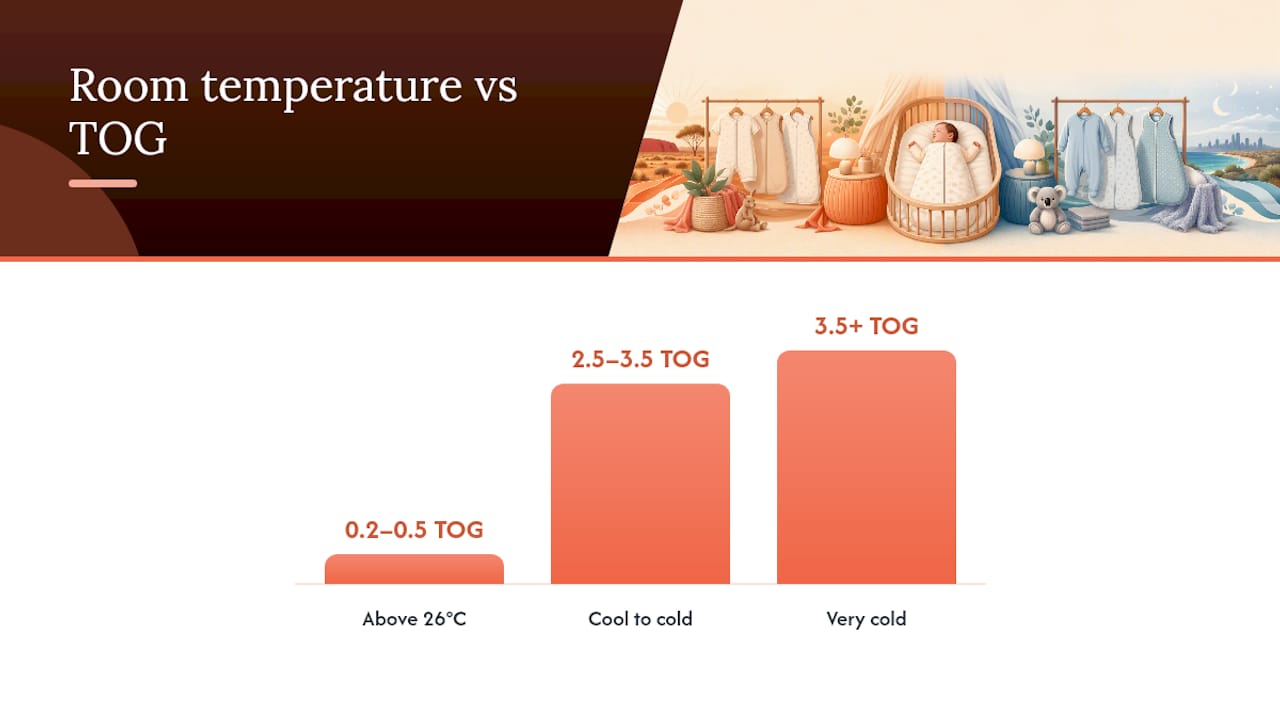
When choosing a sleeping bag, check for a fitted neck and armholes, no hood, correct sizing for the baby’s weight, and a TOG that suits the typical overnight temperature in your home.
Pro Tip: When in doubt, go one layer lighter than you think you need, then feel the chest after 20 minutes. It is much easier to add a layer than to cool an overheated baby mid-sleep.
What should your baby wear tonight? A quick outfit guide
The table above gives you the TOG and underlayer. Here are the specific clothing combinations to reach for at each temperature range.
Quick substitutions worth knowing:
- A singlet bodysuit and a short-sleeve romper are interchangeable in the 22–26°C range
- Socks are optional when using a footed sleeping bag; skip them if the bag already covers the feet
- A short-sleeve romper doubles as a base layer on mild nights without needing a separate bodysuit underneath
- For newborns, a fitted wrap or swaddle replaces the sleeping bag in the early weeks (see swaddling section below)
The Raising Children Network recommends fitted layers and breathable fabrics, and notes that sleeping bags remove the need for loose blankets entirely — a straightforward swap that reduces risk without adding complexity.
How to swaddle safely and when to stop
Swaddling can help newborns settle, but the technique and timing matter. Done incorrectly, it raises the risk of overheating and, once a baby can roll, entrapment.
Safe swaddling practice:
- Use lightweight muslin or cotton — never a thick blanket
- Keep the wrap below the shoulders so the head and face stay fully uncovered
- Leave enough room at the hips for natural movement (tight hip wrapping is linked to hip dysplasia)
- Check the chest and belly for warmth every time you settle the baby
- Never co-sleep with a swaddled baby
Stop swaddling as soon as your baby shows signs of rolling, typically around 3–4 months. At that point, a TOG-appropriate sleeping bag or a suit with sleeves is the safe alternative. The transition does not need to be abrupt — some parents move to a one-arm-out swaddle for a few nights before switching fully to a bag.
Which fabrics and layering strategy work best in Australia?
Australia’s climate varies wildly — a Sydney summer night and a Melbourne winter night can sit 20°C apart — so breathable, natural fibres that work across a range of temperatures are the practical choice for baby nightwear.
Best fabrics for baby sleepwear:
- Organic cotton: soft, breathable, widely available, and gentle on sensitive skin
- Muslin: lightweight and gets softer with every wash; ideal for warm nights and swaddle wraps
- Bamboo blends: naturally moisture-wicking, which helps on humid coastal nights
The layering order is simple: fitted base layer (bodysuit) first, then a light layer if needed, then the sleeping bag on top. Avoid bulky outer pyjamas that trap heat between layers. Fitted sleepwear also helps the sleeping bag sit correctly — baggy fabric can bunch and shift during the night.
Pro Tip: Buy sleepwear one size up for length but not for width. A romper that fits snugly around the torso but has a little extra length is far safer than one that is loose across the chest.
How can you tell if your baby is too hot or too cold?
Feel the chest or back. That is the check. The skin should feel warm and dry — not hot, not clammy, and not cold to the touch. Australian clinical guidance consistently points to the chest or back as the reliable indicator, precisely because hands and feet often feel cool regardless of core temperature.
Signs your baby may be too hot:
- Flushed or red skin
- Rapid or laboured breathing
- Sweating or clammy skin on the chest
- Unsettled, restless sleep
Signs your baby may be too cold:
- Very cool skin on the chest or back
- Unusual lethargy or difficulty waking
- Pale skin
If the baby feels too hot: remove one layer, move them to a cooler area if possible, and check again after a few minutes. If the baby feels too cold: add a layer and recheck. Seek medical help if the baby is difficult to rouse, breathing abnormally, or you are concerned about their colour or responsiveness.
What does a safe cot setup look like?
Clothing choices and cot setup work together. A well-dressed baby in a poorly set-up cot still carries unnecessary risk.
Remove from the cot:
- Loose blankets, doonas, or quilts
- Pillows of any size
- Soft toys and bumper pads
- Lambswool or sheepskin overlays
- Hats or beanies (remove before placing baby down)
Keep in the cot:
- A firm, flat, well-fitting mattress
- A fitted sheet only (if not using a sleeping bag)
- The baby, positioned on their back with feet at the bottom of the cot
Product Safety Australia also flags nightwear fit and flammability as factors in safe sleep — fitted, non-flammable nightwear reduces risk compared to loose or synthetic fabrics. If you use a sheet rather than a sleeping bag, tuck it firmly at chest level so it cannot ride up over the face.
Seasonal tips for Australian homes — summer, winter and everything in between
Australian parents deal with conditions that shift dramatically by region and season, sometimes within a single week.
Hot summer nights (above 24°C):
- Dress in a singlet bodysuit or nappy only with a 0.2–0.5 TOG bag
- Use a ceiling fan set to rotate side-to-side to circulate air — not pointing directly at the baby
- During heatwaves, check the chest more frequently through the night
- For very hot nights, a breathable organic cotton singlet bodysuit alone (no bag) may be appropriate if the room stays above 26°C
Cool to cold winter nights (below 18°C):
- Move to a 2.5–3.5 TOG sleeping bag with a long-sleeve bodysuit or footed suit underneath
- Check that the room heater is not creating a hot spot near the cot; turn it off or down before you go to bed if possible
- No hat at sleep time, even in winter — the head is a key heat-release point for babies
- For Australian winter dressing, layering under the bag is safer than relying on a single thick garment
Variable evenings (coastal humidity, inland temperature drops):
- Layering is your best tool when the temperature swings overnight — remove a layer quickly rather than adjusting heating or cooling as a first response
- Coastal humidity makes bamboo and muslin particularly useful; they wick moisture better than standard cotton
- Inland areas can drop sharply after midnight — check the baby’s chest at your own overnight wake rather than waiting until morning
How this guide was created
This guide draws on the recommendations of four primary Australian authorities: Red Nose Australia, the Raising Children Network, Pregnancy, Birth and Baby, and Product Safety Australia. Where those sources agree, the guidance here reflects that consensus. Where they offer nuance (such as Red Nose’s position that no single room temperature is universally recommended), that nuance is preserved rather than simplified away.
On sources and product mentions: every clothing suggestion in this guide points to garment types — fitted bodysuits, breathable rompers, TOG-rated sleeping bags — that match the clinical guidance above. Product links go only to Baby Goes Retro’s own range of organic, ethically sourced sleepwear. No external retailer or competitor is featured.
Baby Goes Retro has been a family-run Australian business since 2007, built around European organic brands chosen for their breathability, durability, and ethical production. The editorial approach here is the same: safety guidance from authoritative Australian sources comes first, and product suggestions follow only where they genuinely support that guidance.
This article provides general information only and is not a substitute for professional medical advice. For individual concerns about your baby’s health or sleep safety, consult your GP, child health nurse, or call Pregnancy, Birth and Baby on 1800 882 436.
A note on balancing safety and product choices
Safe-sleep guidance and good product choices are not in tension — they point to the same things. Fitted, breathable, natural-fibre sleepwear is both what Red Nose recommends and what Baby Goes Retro has stocked since 2007.
What I find parents underestimate is how much the fit of a garment matters relative to its TOG or fabric. A beautifully organic cotton sleeping bag that is two sizes too large still poses a risk. The guidance is consistent: fitted neck, fitted armholes, correct weight range for the bag, and a snug base layer underneath. Get those four things right and the fabric choice becomes a secondary refinement rather than the primary safety lever.
The other thing worth saying plainly: TOG charts are a starting point, not a guarantee. Night temperatures shift, babies’ metabolic rates vary, and no chart accounts for the specific insulation of your home. The chest-or-back check, done once after the baby settles and again at your overnight wake, is more reliable than any number on a label.
Organic sleepwear that matches safe-sleep guidance
Choosing the right sleepwear does not need to be complicated. Baby Goes Retro carries a curated range of organic cotton playsuits and bodysuits from European ethical brands — the kind of breathable, fitted garments that work exactly as the Red Nose guidance describes.
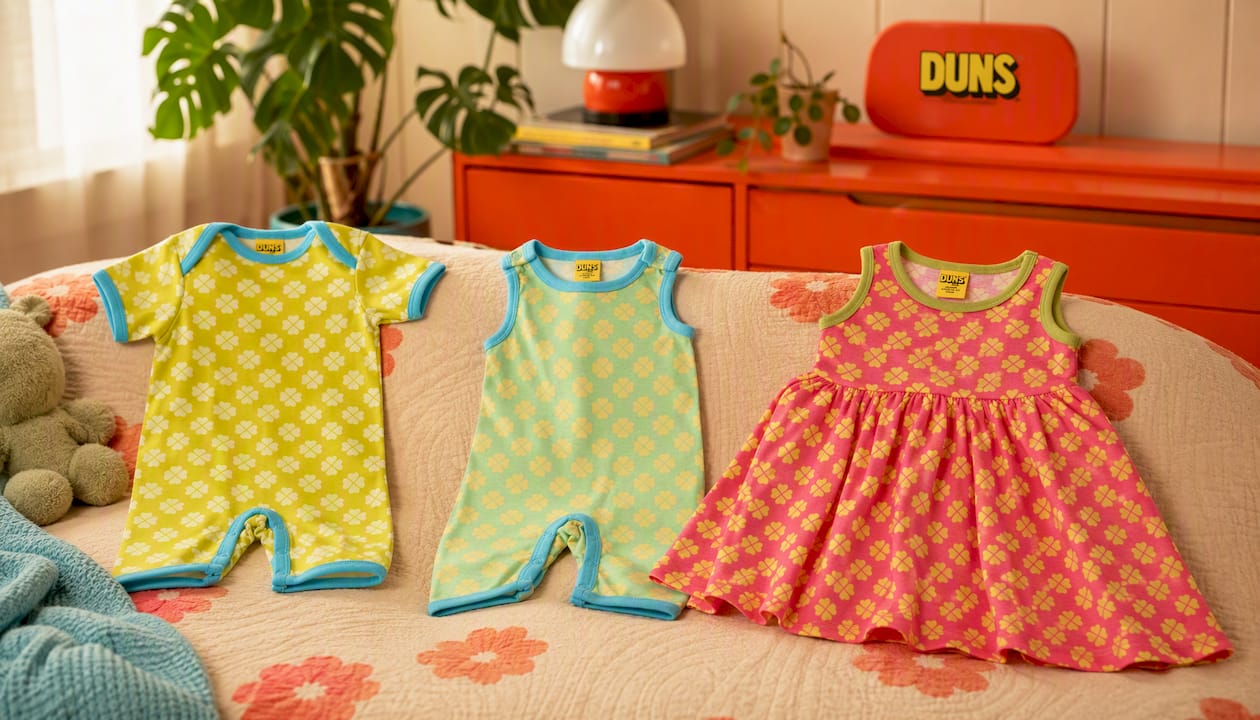
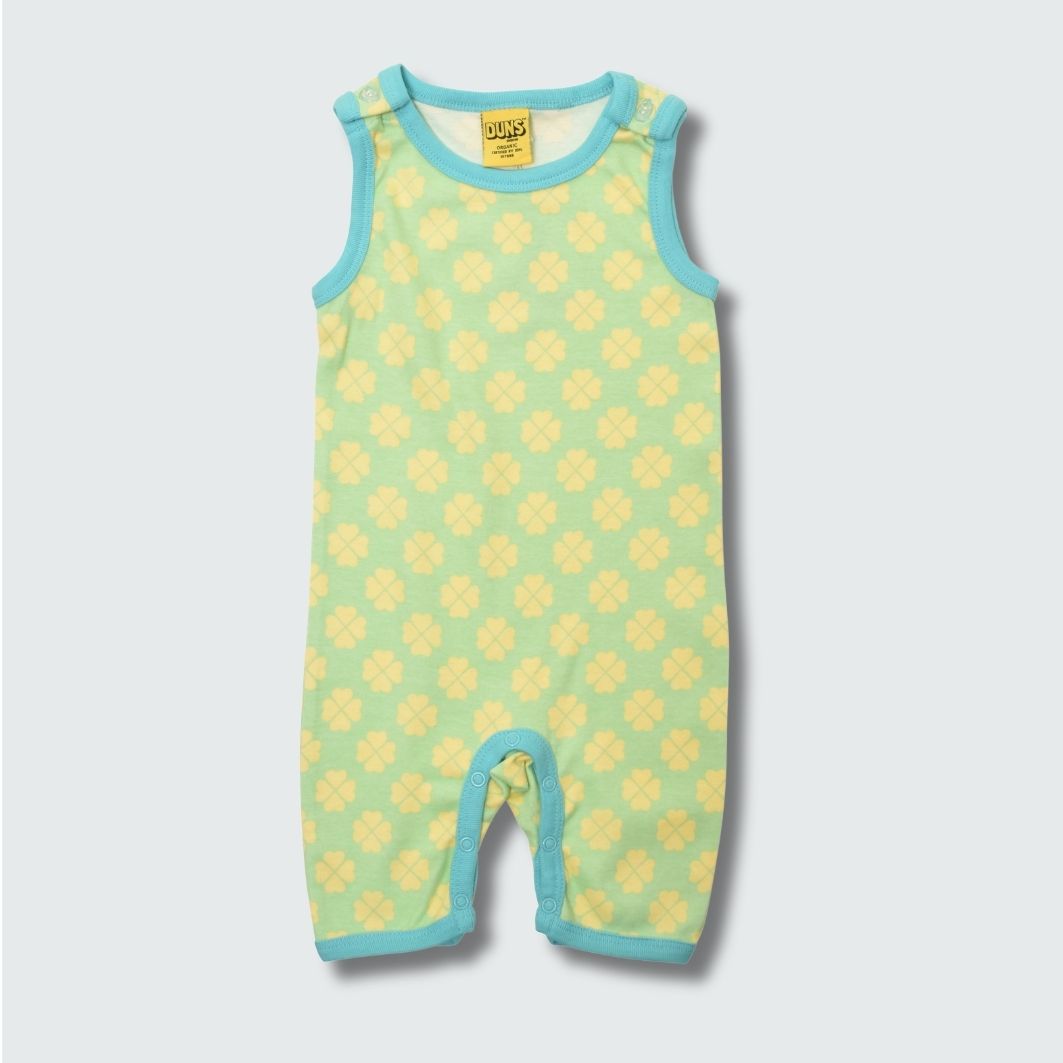
The DUNS Sweden Clover Playsuit in Sulphur Green is a lightweight, fitted organic cotton option that works as a base layer under a sleeping bag on mild nights or as a standalone on warm ones. The Clover Playsuit in Green Ash offers the same breathable construction in a softer colourway, and for older babies on very warm nights, the DUNS Sweden Clover Dress in Hot Pink is a sleeveless option that keeps things cool without sacrificing coverage.
Flat-rate shipping is $7.95 Australia-wide, free on orders over $97, with 30-day easy returns. Browse the full range at Babygoesretro and find the fitted, breathable layer that suits your baby’s next sleep.
Sources
- How to dress baby for sleep | Red Nose Australia
- Dressing your baby in the right clothes for bed | Raising Children Network
- Children’s nightwear guide | Product Safety Australia
FAQ
What is the safest way to dress a baby for sleep in Australia?
Dress your baby in a fitted bodysuit of natural fibre, add a light layer if the room is cool, and place them in a TOG-appropriate sleeping bag with no loose blankets, pillows, or hat. Keep the head and face uncovered at all times.
When should I stop swaddling my baby?
Stop swaddling as soon as your baby shows signs of rolling, which typically happens around 3–4 months. At that point, a correctly sized sleeping bag is the safe alternative, as Raising Children recommends.
How do I know if my baby is too hot during sleep?
Feel the chest or back — it should be warm and dry, not hot or clammy. Flushed skin, rapid breathing, or sweating are signs of overheating; remove one layer and recheck after a few minutes.
What TOG sleeping bag do I need for an Australian summer?
For rooms above 22°C, a medium-low TOG bag over a short-sleeve bodysuit is usually appropriate. On very hot nights above 26°C, a 0.2–0.5 TOG bag or a singlet bodysuit alone may be sufficient, depending on the room temperature.
Do babies need socks or a hat to sleep in winter?
No hat at sleep time, even in winter — babies release heat through their heads, and covering it raises overheating risk. Socks are optional when using a footed sleeping bag; if the bag covers the feet, socks are unnecessary.
0 comments