


Most claims about organic clothing are half true. Organic cotton genuinely skips synthetic pesticides and can be gentler on farmland, but “organic” on a swing tag says nothing about what happened to that fibre in the dye house, whether it lasted longer than the cheap version, or whether it’s actually certified all the way to the finished garment. The honest answer is that organic clothing has real, measurable benefits, but almost every popular claim about it needs a footnote.
Here are the quick corrections worth remembering before you shop:
- “Organic is always pricier” — often true at checkout, but cost-per-wear frequently flips the maths over a garment’s life.
- “Organic clothes are shapeless and dull” — a labelling issue, not a fibre limitation; plenty of organic ranges are as bright and playful as anything else on the rack.
- “Organic fabric doesn’t last” — durability comes down to weave, weight and finishing, not the word “organic” alone.
- “Organic means non-toxic for skin” — farming practices and finished-garment safety are two different things entirely.
- “Organic cuts environmental impact across the board” — it helps in some areas (pesticide load, farmworker exposure) and can fall short in others (yield, water use), depending on where and how it’s grown.
Before you buy, check three things on the product page: the exact fibre composition (not just “organic cotton” buried in marketing copy), whether the finished garment carries a recognised certification such as Global Organic Textile Standard (GOTS), and whether the brand tells you where and how the garment was made.
Key Takeaways
Genuine organic clothing benefits depend on finished-product certification, honest cost-per-wear maths, and transparency, not the word “organic” alone.
| Point | Details |
|---|---|
| Certification beats buzzwords | Check for a finished-product standard like GOTS, not just an “organic cotton” fibre claim. |
| Cost-per-wear reveals true value | Divide price by expected wears; durable organic pieces often beat cheap fast fashion over time. |
| Environmental impact varies by region | Organic farming lowers pesticide use but can mean lower yields, so context matters more than the label. |
| Health claims need a second check | Farming-focused organic labels don’t guarantee residue-free processing; look for finished-garment testing too. |
| Baby Goes Retro sources with transparency | The shop favours GOTS-referenced, European-made kidswear backed by AUD pricing, $7.95 flat shipping (free over $97), and 30-day returns. |
Table of Contents
- Debunking the biggest organic clothing myths
- What the research actually says about organic’s environmental impact
- How to verify organic claims before you buy
- Care tips that actually extend a garment’s life
- Why we look past the label at Baby Goes Retro
- Where to find genuinely vetted organic kidswear
- Sources
- FAQ
Debunking the biggest organic clothing myths
Myths about organic fashion tend to survive because they’re half right, and half right is enough to keep spreading on social media and in marketing copy. Here’s what actually holds up when you look at each claim on its own.
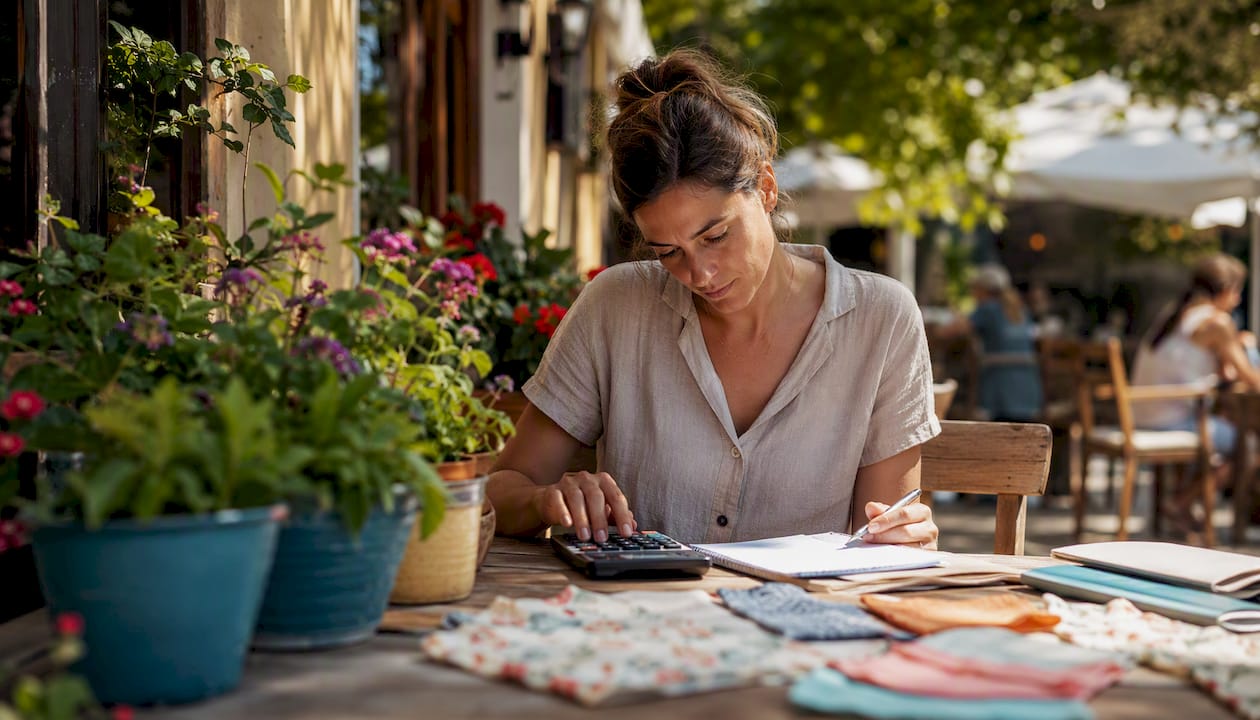
Myth 1: Organic clothing always costs more. At the till, this is often true. Sustainably produced garments typically run 20 to 40% higher than fast-fashion equivalents. But price at purchase isn’t the same as price per wear, and a $45 organic romper that survives three kids and forty washes is cheaper, per outing, than a $15 one that pills and stretches out after six weeks. Pro tip: Before you baulk at a price tag, do the maths on cost-per-wear rather than sticker price alone. It changes which item actually looks expensive.
Myth 2: Organic clothing isn’t stylish. This one is pure hangover from the early 2000s, when “eco fashion” meant beige linen and not much else. Consumer guides now note that organic cotton isn’t automatically softer, brighter, or higher quality than conventional cotton purely because of the label. What actually determines look and feel is fibre grade, weave and finishing. Plenty of organic kidswear brands now print in bold colour and retro patterns precisely because that “worthy but boring” reputation was costing them customers.
Myth 3: Organic fabric doesn’t hold up to kids. Durability is a function of stitching quality, fabric weight and how a garment is cared for, not whether the cotton was grown organically. A poorly constructed organic tee will rip just as fast as a poorly constructed conventional one. What tends to happen in practice is that brands marketing organic ranges also invest more in construction quality, so the two get bundled together in people’s minds when they’re not actually the same thing.
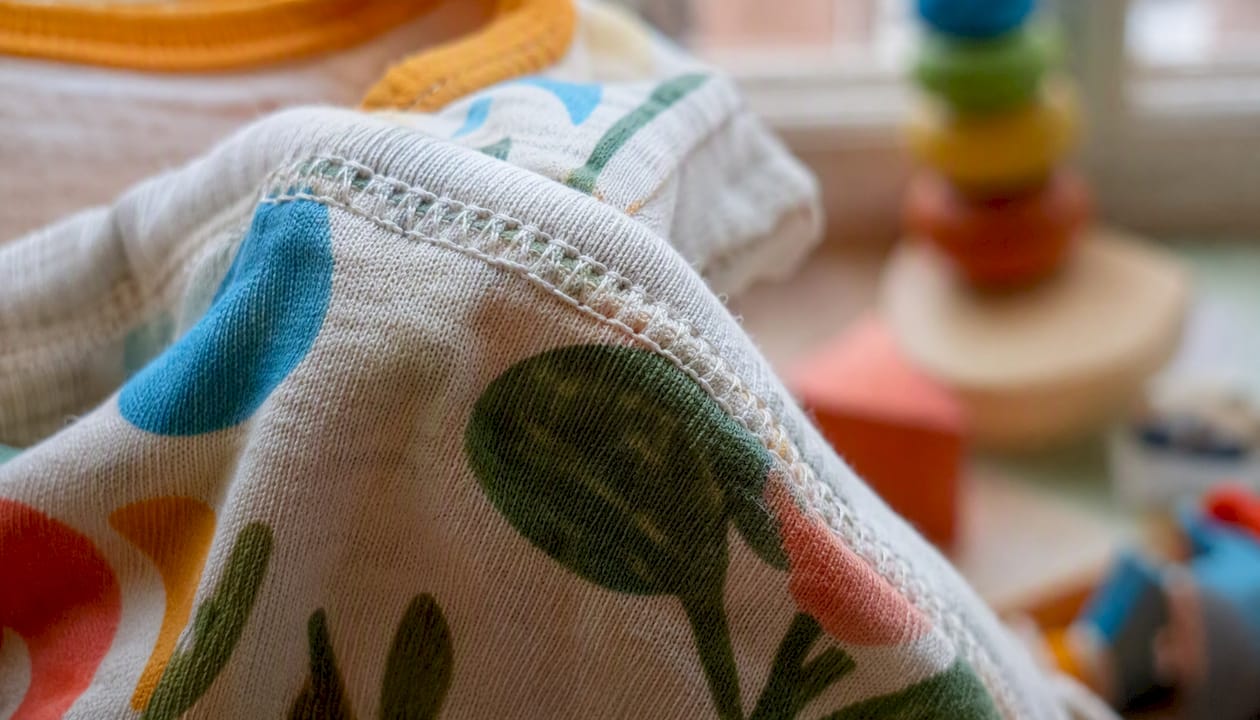
Myth 4: Organic automatically means safer for skin. This is the myth worth taking most seriously, because it’s the one parents are most likely to act on for the wrong reasons. Organic farming standards govern how the raw fibre is grown, not what happens afterwards. Processing, dyeing and finishing, not the farming step, are usually the source of residual chemicals in finished garments, and organic labelling alone doesn’t guarantee a residue-free result. If skin sensitivity is a genuine concern, look for a finished-product certification with chemical testing built in, rather than trusting the word “organic” on its own.
Myth 5: “Organic” and finished-garment certification mean the same thing. They don’t, and this gap is where a lot of marketing slips through. It says nothing about the dyes, the finishing chemicals, or the labour used to sew the garment. Only GOTS certifies the entire chain from farm to finished product, which is why a garment can legitimately say “organic cotton” without being GOTS-certified at all.
Myth 6: Organic automatically means low environmental footprint. Organic farming removes synthetic pesticides, which is a genuine win for soil health and the people working the fields. But it typically also produces lower yields than conventional growing, so its water and land impact per garment can vary a lot depending on region and irrigation. “Organic” is a farming method, not a full environmental scorecard.
Myth 7: Any blend with “organic” in the name is mostly organic. Terms like “contains organic cotton” or “made with organic materials” can describe a garment where organic fibre makes up a small share of the total blend. Greenwash-style phrasing like this is legal but misleading if you assume it means the whole garment. Always check the exact percentage on the fibre content label, not just the marketing headline.
Myth 8: Ethical labour is guaranteed by an organic tag. Organic certification covers farming inputs, not factory wages or working conditions. A garment can be grown organically and still be sewn in a facility with no independent labour audit. If ethical manufacturing matters to you as much as the fibre itself, look for supply-chain transparency as a separate checkbox, not an assumption that comes bundled with “organic.”
What the research actually says about organic’s environmental impact
Organic clothing isn’t a blanket sustainability win, and treating it as one is where a lot of good intentions go sideways. The real picture depends on where the cotton was grown, how it was irrigated, and what happened after harvest.
Organic cotton farming skips synthetic pesticides, which measurably reduces chemical exposure for farmworkers and improves soil biology over time; for more on alternatives to organic cotton and recycled fibres, see recycled fabric clothing explained for eco-conscious style. The trade-off is yield: organic cotton typically produces 20 to 30% less fibre per hectare than conventional cotton. That means growing the same amount of clothing organically can require more land or water, depending entirely on the region and how the crop is irrigated. Organic isn’t a fixed environmental result. It’s a farming method whose impact shifts with geography.
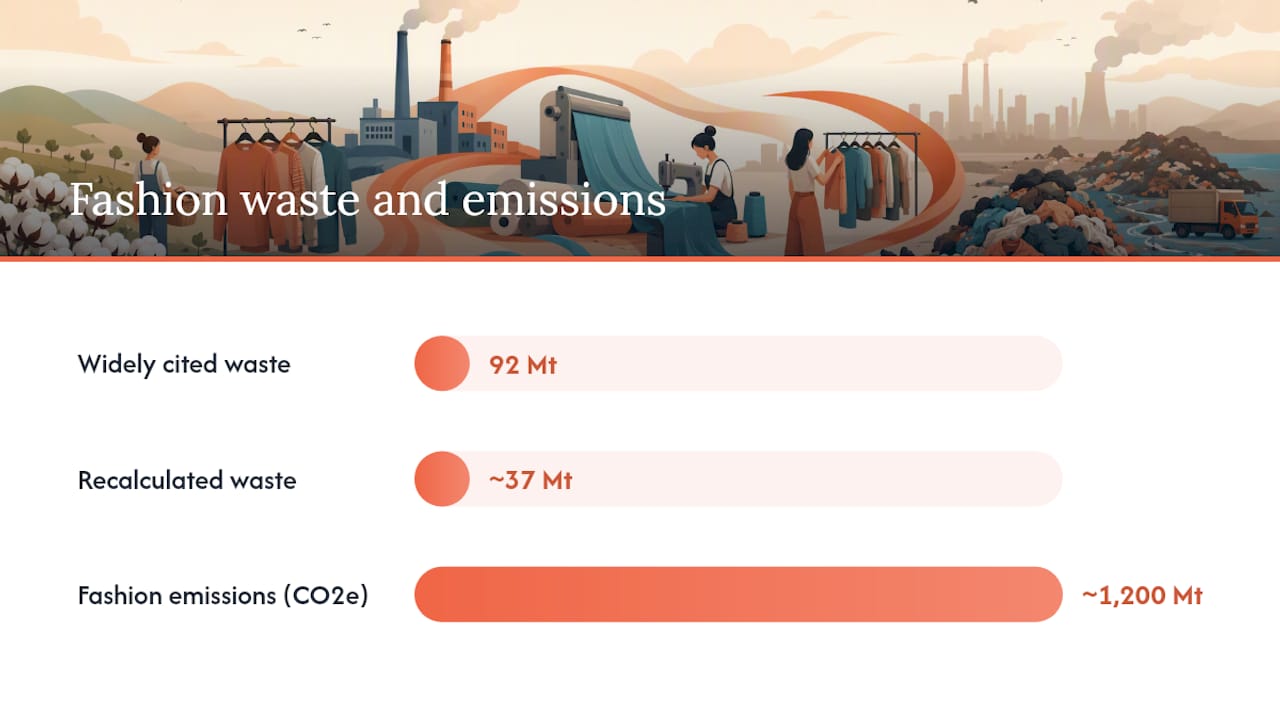
Headline statistics about fashion’s environmental toll deserve the same scrutiny. A widely repeated figure claims the industry generates 92 million tonnes of textile waste a year. A closer re-calculation of the original 2015 data puts the more accurate figure closer to 37 million tonnes. That’s still a serious number, but it’s less than half the viral claim, and it’s a useful reminder to check the source behind any statistic that sounds designed to shock rather than inform. On emissions, the picture is clearer: the global fashion industry produced roughly 1.2 billion tonnes of CO2e in 2024, and most of that comes from manufacturing and processing volume, not the choice between organic and conventional fibre.
| Metric | Widely cited figure | More accurate figure | Source |
|---|---|---|---|
| Global textile waste (annual) | 92 million tonnes | ~37 million tonnes (2015 re-calculation) | Clean Up |
| Global fashion emissions (2024) | Not applicable | ~1.2 billion tonnes CO2e | Sustainability Atlas |
| Organic cotton yield vs conventional | Not applicable | 20–30% lower per hectare | Sustainability Atlas |
Life-cycle assessments back up the “it depends” conclusion rather than a clean verdict either way. Comparative studies, including work referenced by Sustainability Atlas, find that organic cotton’s advantage over conventional cotton shifts depending on the growing region, the irrigation method, and how far the finished garment travels before it reaches a shop shelf. A locally processed organic garment can outperform a conventional one shipped across three continents, and the reverse is just as possible. Rather than asking “is it organic,” a more useful question is “where was it grown, how was it processed, and how far did it travel.”
How to verify organic claims before you buy
A swing tag that says “organic cotton” is a starting point, not proof. Here’s the checklist worth running through on any product page.
- Look for a finished-product certification, not just a fibre claim. GOTS is currently the main standard that audits the entire chain from farm to finished garment, covering processing, dyeing and labour practices along the way, not just how the raw cotton was grown.
- Check for a GOTS licence number. A genuine GOTS-certified product carries a licence number you can look up in the public registry. If a brand can’t produce one when asked, treat the “organic” claim as unverified.
- Read the full fibre composition, not the headline. Watch for phrasing like “exclusive of elastic” or “contains organic cotton,” which can mask a low percentage of actual organic fibre in the finished blend.
- Look for OEKO-TEX alongside GOTS, not instead of it. OEKO-TEX tests for harmful residues in the finished textile, which is a different (and complementary) check to GOTS’s farm-to-factory audit.
- Ask about supplier transparency. A brand that names its factories, mills or farms is giving you something you can actually verify. Vague language like “ethically made” with no detail is a signal to dig deeper.
Beyond certification, run the numbers. Cost-per-wear is simple: divide the purchase price by the number of times you expect to wear the garment. A $50 organic dungaree worn 100 times before it’s handed down costs 50 cents a wear. A $20 fast-fashion equivalent worn 15 times before it falls apart costs $1.33 a wear, more than double, despite the lower price tag.
- Fibre composition should be listed in full, including any elastane or blend percentage.
- Certification claims should reference the finished product, not just the raw fibre.
- Supplier or factory information should be available somewhere on the site, even if it’s not front and centre.
- Country-of-origin labelling matters too. Australian Competition and Consumer Commission (ACCC) guidance recommends checking origin and composition details rather than relying on marketing language alone.
On the labour side, look for signals like third-party labour audits or named manufacturing partners rather than taking “ethically made” at face value. A brand that’s willing to show its supply chain is usually more trustworthy than one that only talks about it in the abstract.
Care tips that actually extend a garment’s life
The single biggest lever you have over a garment’s environmental footprint, after you’ve bought it, is how long you keep it in rotation. Good care habits do more for sustainability than almost any purchasing decision.
- Wash at lower temperatures where the care label allows it. It’s gentler on fibres and cuts energy use per load.
- Turn garments inside out before washing to protect prints and reduce surface friction.
- Air-dry when you can. Tumble drying is the fastest way to wear down elastane and shrink natural fibres.
- Repair small holes and loose seams before they become big ones. A five-minute patch job can add months of wear.
- Rotate the wardrobe rather than relying on the same three favourites. Even distribution across garments slows wear on any single piece.
- Buy one size up where practical. A slightly roomy fit at first extends the usable window at the other end.
The cost-per-wear formula is worth running on your own wardrobe: purchase price divided by expected wears. Say a pair of organic dungarees costs $65 and lasts through 120 wears across two kids. That’s roughly 54 cents per wear, well below a $25 fast-fashion pair that manages 20 wears before the knees blow out, at $1.25 per wear. Durability isn’t just an ethical nice-to-have. It’s the maths that makes organic clothing genuinely better value.
Pro tip: Keep a small stash of spare press studs and elastic on hand. Most wear-and-tear on kids’ clothing happens at fastenings, and a two-minute fix at home is far cheaper than replacing the whole garment.
Why we look past the label at Baby Goes Retro
Running a family business since 2007 has taught us that “organic” is a word that gets stretched to cover a lot of ground, and not all of it fairly. We’ve spent years sourcing from European brands that treat certification as a baseline, not a marketing flourish, which means we lean towards suppliers who can show their GOTS documentation rather than ones who simply print “organic” on a hangtag and hope nobody asks further questions.
We also believe the practical stuff matters as much as the values behind it. Every price on our site is in AUD, shipping is a flat $7.95 (free once your order passes $97), and every purchase comes with 30-day returns and exchanges, so if a size or style doesn’t work out, sorting it isn’t a hassle. When we say a piece is organic or GOTS-referenced, it’s because we’ve checked the same things this article just walked you through: fibre composition, licence verification, and supplier transparency.
Where to find genuinely vetted organic kidswear
If everything above has you wondering where to start, Baby Goes Retro carries a curated range of European organic and GOTS-referenced kidswear built for exactly the durability this article has been talking about. These aren’t garments picked for a trend cycle. They’re chosen because they survive the wash cycle, the hand-me-down cycle, and the toddler-attacking-a-mud-puddle cycle.
Pieces like the DUNS Sweden Clover Capri dungarees and the bistro green Clover dungarees show exactly what a transparent product page should look like: full fibre composition, clear origin details, and colour that has nothing to do with beige “eco fashion” stereotypes.
- AUD pricing on every product page, no conversions or surprises at checkout.
- Flat-rate shipping of $7.95, free once your order goes over $97.
- 30-day easy returns and exchanges if a size or style doesn’t quite fit.
Have a browse of the full Baby Goes Retro range and see for yourself what a garment built to survive childhood actually looks like.
Sources
FAQ
Is wearing organic clothes good for you?
Organic clothing can reduce your exposure to pesticide residues from farming, but finished-garment safety depends more on processing, dyes, and finishes than on the organic label alone. If skin sensitivity is a concern, pair an organic claim with a finished-product certification that tests for chemical residues.
What is the 3-3-3 rule for clothes?
This isn’t a standard or scientifically defined rule within organic textile certification, so definitions vary depending on the source. Rather than relying on an informal rule, use the fibre composition label and a recognised certification like GOTS to judge a garment’s credentials.
Why is nothing 100% cotton anymore?
Many garments blend cotton with elastane or synthetic fibres to improve stretch, fit, and shape retention, especially in kids’ clothing that needs to move with an active child. Always check the full fibre list, since a small percentage of blended fibre doesn’t cancel out genuine organic cotton content in the rest of the garment.
Is cotton toxic if not organic?
Conventional cotton farming uses synthetic pesticides that raise chemical exposure during growing, but that’s a separate issue from whether the finished garment carries chemical residues. Both organic and conventional garments can carry processing residues if they lack finished-product testing, which is why certification and transparent supplier information matter more than the organic label by itself.
0 comments