


Yes, PFAS turn up in children’s clothing more often than most parents realise. A widely cited textile study found PFAS in 64% of children’s outerwear samples tested, and NSW Health lists clothing among the everyday products where these chemicals persist. The first move is simple: favour untreated natural fibres for daily wear, save water-resistant or stain-proof pieces for genuine wet-weather use, and wash new clothes before your child wears them.
- Prevalence: independent testing has repeatedly detected PFAS in treated children’s garments, especially outerwear and stain-resistant uniforms.
- Guidance: enHealth recommends a precautionary approach to PFAS exposure generally, given how long these chemicals persist in the body.
Pro Tip: Reach for plain, breathable natural fibres for everyday clothing and reserve any “waterproof” or “stain-resistant” gear strictly for the occasions it’s actually needed.
Key Takeaways
Children’s clothing frequently carries PFAS coatings for water and stain resistance, and reducing exposure comes down to choosing untreated natural fibres and washing new garments before first wear.
| Point | Details |
|---|---|
| PFAS are common in treated garments | Testing found PFAS in 64% of children’s clothing samples, concentrated in outerwear and stain-resistant items. |
| PFAS is a coating, not a fibre property | Both natural and synthetic fabrics can be PFAS-free or treated, so check the finish, not just the fibre. |
| Marketing claims are your clue | “Waterproof,” “stain-resistant,” and “easy care” labels signal a likely chemical finish worth questioning. |
| Washing helps but has limits | New clothes should be washed before wear, but this removes surface residue, not chemically bonded PFAS. |
| Choose plain natural basics | Baby Goes Retro’s organic cotton pieces, like the Kite Pig Pannage Bodysuit, avoid unnecessary performance finishes. |
Table of Contents
- What is PFAS in kids’ clothing, and why is it there?
- Which clothes and labels signal PFAS treatment?
- How are kids exposed, and how strong is the health evidence?
- How common is PFAS in children’s clothes, and what does regulation say?
- How can you reduce PFAS exposure from clothing at home?
- What should you ask a brand before you trust the label?
- Can lab testing or a blood test settle the question?
- Choose natural fibres your kids can actually live in
- Sources
- FAQ
What is PFAS in kids’ clothing, and why is it there?
PFAS stands for per- and polyfluoroalkyl substances, a family of thousands of synthetic chemicals engineered to repel water, grease, and stains. Manufacturers have relied on them since the 1940s, and they show up everywhere from non-stick cookware to carpets to children’s clothing.
Here’s the part most parents don’t know: PFAS aren’t woven into the fibre itself. They’re applied as a surface coating or finish, sprayed or dipped onto a finished fabric, which means both natural fibres like cotton and synthetic ones like polyester can carry a PFAS treatment, or neither can. A “100% cotton” label tells you nothing about whether that cotton was later treated.
Textile manufacturers reach for PFAS finishes to create:
- Water-repellent rain jackets and puffer coats
- Stain-resistant school uniforms and formal wear
- “Performance” activewear marketed as moisture-wicking
- Easy-care, wrinkle-free or non-iron fabrics
The scale is worth sitting with. Government documentation confirms these chemicals span thousands of individual compounds across consumer goods, which is exactly why blanket claims like “PFOA-free” mean far less than they sound. One compound being absent says nothing about the other several thousand.
Which clothes and labels signal PFAS treatment?
Some garments carry a genuinely higher chance of PFAS finishes than others, and the marketing language on the swing tag is often your best early warning.
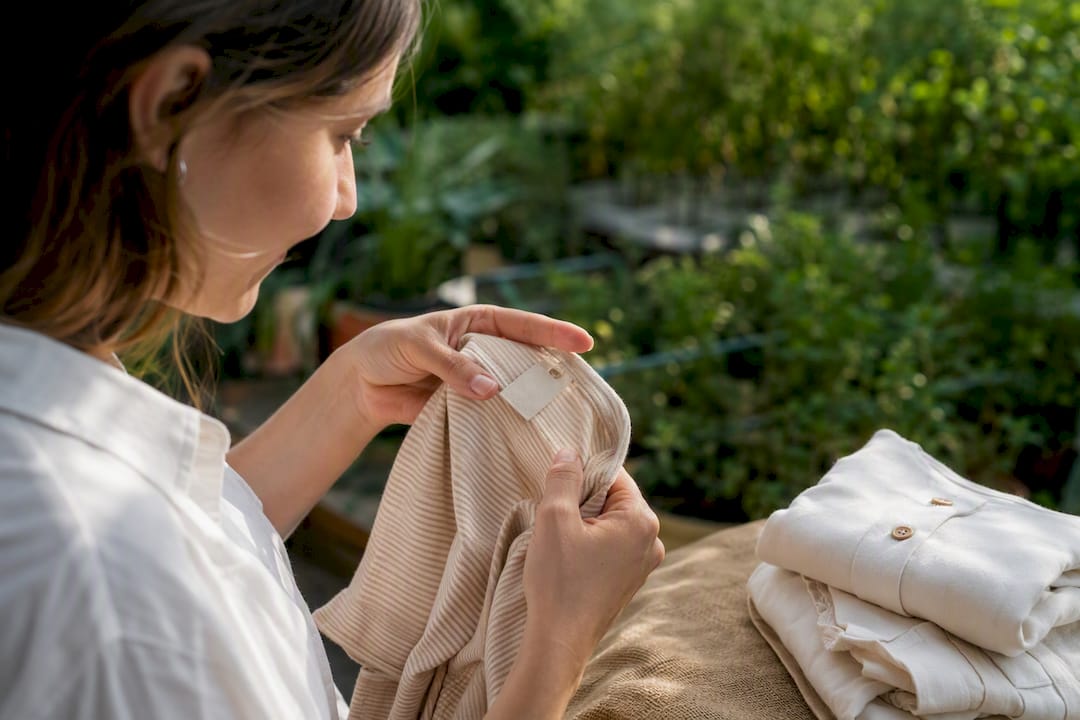
Outerwear tops the list. Rain jackets, puffer coats, and anything pitched as “weatherproof” almost always relies on a chemical finish to stay water-resistant, because that’s not a property most fabrics have naturally. School uniforms treated for stain resistance come next, followed by “performance” activewear and water-resistant playwear designed for splash parks or muddy backyards.
Watch for these words on tags and product pages:
- “Waterproof” or “water-repellent”
- “Stain-resistant” or “dirt-repellent”
- “Moisture-wicking”
- “Easy care” or “wrinkle-free”
- “Non-iron”
None of these terms guarantee a PFAS finish. Some brands now achieve water resistance through tighter weaves or wax-based coatings instead. But the presence of any of these claims is a genuine prompt to ask the brand what finish they’ve actually used, particularly for everyday basics where there’s no functional need for stain or water resistance in the first place. Specialist safety gear is a different case, where fire- or chemical-resistant properties can be legitimately essential and harder to replace.
Pro Tip: Prioritise checking or replacing garments worn tight against the skin for long stretches, like uniforms and bodysuits, over occasional-use items like a rain jacket only worn a handful of days a year.
How are kids exposed, and how strong is the health evidence?
Clothing isn’t the main way PFAS gets into a child’s body. enHealth’s own exposure data points to food and drinking water as the dominant routes for most people. But clothing contributes through several plausible pathways worth understanding:
- Dermal contact: direct skin absorption from treated fabric, particularly relevant for tight-fitting items worn for hours
- Hand-to-mouth transfer: kids touch treated fabric, then put their hands in their mouths
- Household dust: PFAS can shed from treated textiles and accumulate in carpet and dust, which toddlers inhale or ingest at floor level
- Laundry residues: washing can redistribute surface chemicals onto other garments in the same load
On health effects, the honest answer is that the evidence is real but not settled. enHealth’s guidance statement lists associations between PFAS accumulation and changes in cholesterol, some immune and hormone indicators, reduced kidney function, and small shifts in developmental markers. Critically, the same guidance stresses that many of these observed differences are small and the research base is still evolving. This isn’t a chemical you want to shrug off, but it’s also not one where the science supports panic.
Children carry particular vulnerability here. They eat, drink, and breathe more relative to their body weight than adults do, and their immune and endocrine systems are still developing. That’s the specific reasoning behind enHealth and NSW Health’s shared recommendation for a precautionary approach: minimise exposure where it’s practical, without needing definitive proof of harm first. Separately, the International Agency for Research on Cancer has specifically evaluated PFOA and PFOS for carcinogenicity, giving those two compounds a more detailed hazard profile than most of the PFAS family.
How common is PFAS in children’s clothes, and what does regulation say?
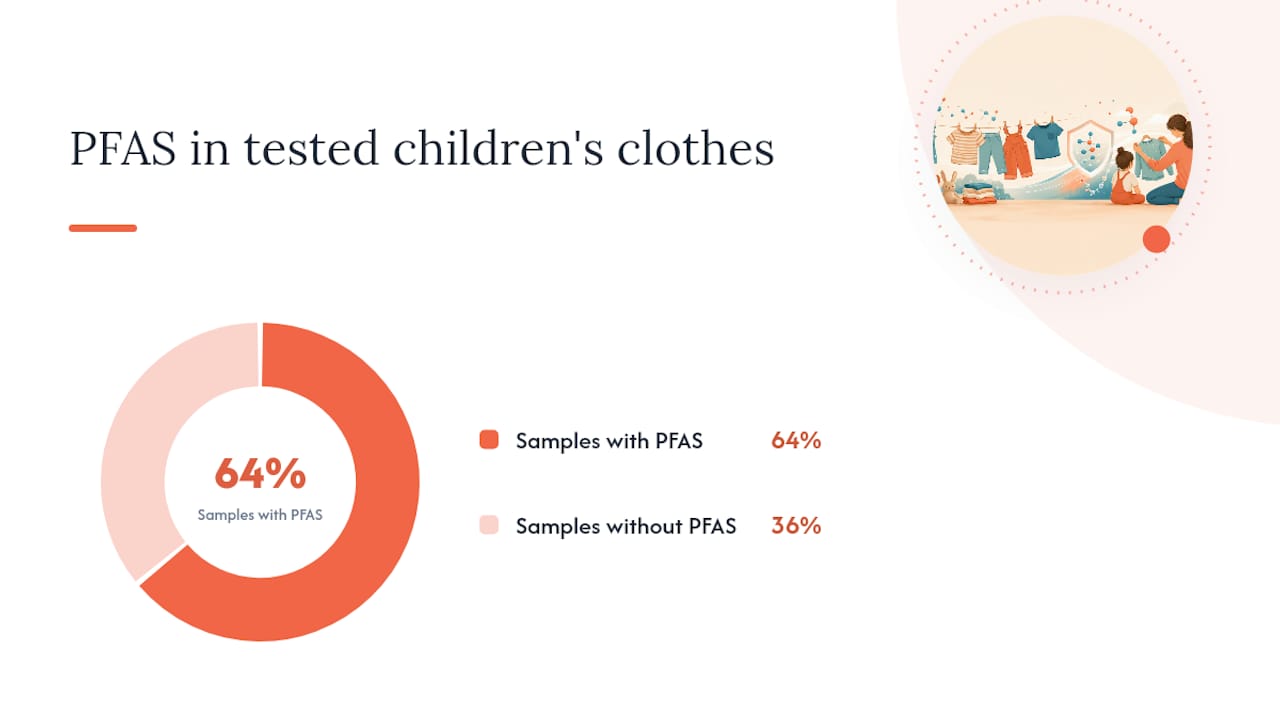
The prevalence numbers are the reason this topic deserves attention rather than dismissal. Testing summarised in Australian reporting found PFAS in 46 of 72 children’s clothing samples tested, or 64%, concentrated heavily in outerwear marketed as waterproof or stain-resistant.
Regulation hasn’t caught up with that finding yet. Here’s where things stand:
- Australia banned three specific PFAS compounds in 2025, but there’s no mandatory, apparel-wide PFAS ban
- Some US states have introduced broader restrictions on PFAS in children’s products and textiles specifically
- A federal parliamentary inquiry recommended Australian governments consider restricting non-essential PFAS uses in textiles, given how many alternatives already exist
- Independent Australian textile testing remains limited, meaning much of what we know comes from overseas studies and investigative journalism rather than routine local surveillance
For now, keeping kids away from PFAS-treated clothing relies more on informed parental choice than on any regulatory guarantee.
How can you reduce PFAS exposure from clothing at home?
You don’t need to overhaul a wardrobe overnight, but a few consistent habits make a real difference over time.
When you’re buying:
- Choose plain, untreated natural fibres like cotton or wool for everyday basics
- Look for garments explicitly labelled “PFAS-free,” “PFC-free,” or “fluorocarbon-free,” and be sceptical of “PFOA-free” alone since that only rules out one compound
- Skip “performance” finishes such as stain resistance or non-iron treatments on clothes with no functional need for them, like everyday tees and bodysuits
When you’re washing: Wash new clothes before their first wear to remove surface residues from manufacturing and shipping. Skip fabric softeners and don’t apply aftermarket waterproofing sprays, which often contain PFAS themselves. It’s worth being clear-eyed here: washing reduces loose surface residue, but it won’t strip out PFAS that’s chemically bonded to the fabric finish. A wash cycle is harm reduction, not a cure.
Everyday habits that help: Rotate garments rather than relying on one heavily worn favourite, since sweat and friction during active play may increase how much PFAS leaches from a treated coating. Breathable natural fibres suit high-activity periods far better than treated synthetics. Wash sweaty sports kit promptly rather than leaving it in a hamper, and keep bedroom dust down with regular HEPA vacuuming and damp dusting, since dust is one of the pathways PFAS can accumulate through indoors.
Pro Tip: Don’t feel pressured to bin an entire wardrobe overnight. Replace the highest-contact items first, like uniforms and everyday layers, and let occasional-use outerwear reach the end of its natural life before replacing it. That’s a better balance of health caution and environmental sense than wholesale disposal.
What should you ask a brand before you trust the label?
A handful of direct questions will tell you more than any marketing claim on a swing tag.
- “Does this garment use any PFAS-based finish or coating?”
- “Do you test finished garments for PFAS, and can you share the results?”
- “Is this item certified PFAS-free, and does that cover the whole finished garment or just the raw fibre?”
A meaningful answer points to independent, third-party testing and discloses materials in full, rather than offering a vague reassurance. Genuine finished-garment testing matters more than a fibre-only claim, because remember, PFAS is applied as a coating after the fibre exists.
Pro Tip: If a brand’s answer feels evasive, ask for a Material Safety Data Sheet or a finished-garment test result. Treat “PFOA-free” on its own as a red flag rather than reassurance. It rules out one compound out of thousands.
Baby Goes Retro’s organic cotton basics reflect exactly this kind of straightforward, single-material approach, favouring plain natural fibres over unnecessary performance finishes on everyday pieces.
Can lab testing or a blood test settle the question?
Finished-garment lab testing for PFAS exists, but it’s specialised and typically expensive for an individual parent to commission. A positive result confirms presence; it doesn’t tell you how much has transferred to skin or how it compares to other exposure sources.
Blood testing for PFAS is also available, though NSW Health and enHealth are both clear that a result won’t predict specific health outcomes for your child. Talk to a GP if:
- You suspect a known high-exposure scenario (occupational exposure at home, for instance)
- You live near a site with documented PFAS contamination
- You have pregnancy-related concerns about cumulative exposure
A retailer’s perspective on fabric choices
At Baby Goes Retro, we’ve chosen organic, natural fibres from day one, not as a reaction to PFAS headlines, but because they’re simply better on little skin and better for the planet. Since 2007, we’ve built relationships with European manufacturers who share that same ethical, low-intervention approach. Families don’t need to choose between safety and durability. Good natural fibres genuinely deliver both.
Choose natural fibres your kids can actually live in
Baby Goes Retro is the alternative to guessing at swing-tag claims: every piece in our organic range is built around plain, natural fibres rather than layered-on performance finishes, so you’re not left decoding “moisture-wicking” or “easy care” labels before you buy. Our Kite Pig Pannage Long Sleeve Bodysuit is a straightforward organic cotton basic, exactly the kind of everyday, skin-contact item worth prioritising first. For new parents building a wardrobe from scratch, the Kite Koala Time Baby Gift Bundle and the Kite Pear-fect Dungaree Toddler Bundle offer natural-fibre basics without the unnecessary “stain-resistant” or “wrinkle-free” add-ons.
We ship Australia-wide for a flat $7.95, free once your order passes $97, and every purchase comes with 30-day easy returns and exchanges if something isn’t quite right. Browse our full range of organic kidswear and build a wardrobe you feel genuinely good about.
Sources
For deeper reading on the science and policy behind this topic:
This article is general information, not a substitute for advice from a qualified doctor. Consult a qualified healthcare professional about your own circumstances before acting on anything here.
FAQ
Can PFAS be washed off clothes?
Washing removes some loose surface residue but won’t strip out PFAS that’s chemically bonded into the fabric’s finish. Washing new clothes before first wear is still worthwhile, just don’t treat it as a complete fix.
Which clothing brands contain PFAS?
Independent testing hasn’t named a definitive list of affected brands, but PFAS turns up most often in outerwear, stain-resistant uniforms, and “performance” activewear across the market. Ask any brand directly whether their finished garments have been tested, rather than assuming any single label is safe by name alone.
What Australian products contain PFAS?
Beyond clothing, PFAS have historically appeared in firefighting foam, some carpets, furniture treatments, and food packaging in Australia. Australia banned three specific PFAS compounds in 2025, though broader apparel restrictions haven’t followed yet.
How do I know if clothes have PFAS?
Check for “waterproof,” “stain-resistant,” or “easy care” language on the tag, and ask the brand directly whether the finished garment has been tested for PFAS. Choosing plain, untreated natural fibres, like the organic basics Baby Goes Retro stocks, sidesteps the question for everyday wear entirely.
0 comments