


For everyday bodysuits and tees, jersey is the smarter pick. It’s smooth, breathable, and gentle on newborn skin. For cuffs, necklines, and fitted pieces like leggings, ribbed knit takes over. It stretches further and snaps back into shape. Choose organic, combed cotton where you can, and check for OEKO-TEX or GOTS labelling on the product. Baby Goes Retro stocks both, so you rarely have to compromise.
TL;DR:
- Ribbed knit fabric stretches significantly more (150 to 200%) and recovers better than jersey, making it ideal for trims and fitted pieces.
- Jersey fabric feels smoother and is more breathable, preferred for bodysuits and everyday clothing, especially on sensitive skin.
- Heavier fabrics like interlock are better for cooler months and offer more opacity and stability, while lighter jersey suits warmer conditions.
- Garments with flatlock seams and OEKO-TEX or GOTS certification reduce skin irritation and ensure safety.
- Mixing jersey for basics and rib for trims creates versatile, growth-friendly baby clothes that last through wash and wear.
Table of Contents
- Ribbed vs jersey baby clothes at a glance
- Why do ribbed and jersey fabrics feel so different?
- Which fabric suits sensitive baby skin best?
- Which garments work best in each fabric?
- How should you wash and care for these fabrics?
- How do you choose between ribbed and jersey?
- How does Baby Goes Retro put this into practice?
- A quick note from Daniel
- Where to find matching rib and jersey pieces
- Sources
- FAQ
Ribbed vs jersey baby clothes at a glance
Before you dig into the “why,” here’s the quick contrast most parents actually need.
- Stretch: jersey moves mostly one way, giving roughly 25 to 40% flexibility; rib stretches in both directions and can reach 150 to 200% of its resting width.
- Recovery: rib bounces back into shape far more reliably, which is exactly why it’s used at necklines and cuffs.
- Texture: jersey feels flat and smooth; rib has visible vertical ridges with a bit more grip against skin.
- Weight and season: single jersey usually sits lighter (great for warmer days), while rib and interlock run heavier and suit cooler months.
- Durability: rib tends to hold its “like new” shape longer in high-stress spots such as necklines and waistbands.
- Best uses: jersey for bodysuits, tees, and everyday basics; rib for trims, cuffs, and fitted newborn pieces.
Shopping tip: look for phrases like “1×1 rib” or “combed single jersey” on product pages, and check whether the fabric is preshrunk. If you’re after a bold, colourful print, jersey or interlock will show it off far better than a textured rib ever could.
Why do ribbed and jersey fabrics feel so different?
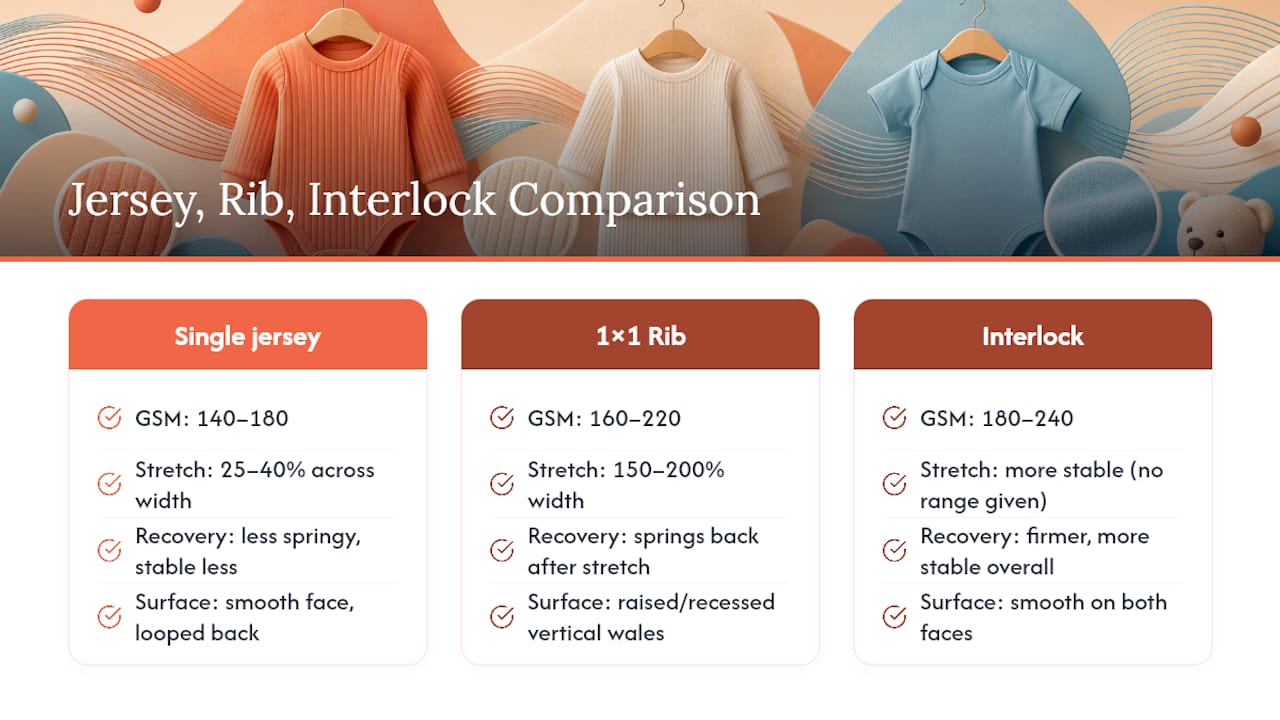
The difference comes down to how the yarn is looped, not just what it’s made from. Single jersey is knitted in one continuous direction, creating a smooth face on one side and slightly looped texture on the back. That construction gives it stretch mainly across the width, which explains the 25 to 40% flexibility figure you’ll see quoted for standard jersey.
Rib knit, particularly 1×1 rib, alternates knit and purl columns (called wales) running vertically down the fabric. Those raised and recessed columns act almost like tiny springs, letting the fabric stretch to 150 to 200% of its resting width and pull back into shape afterwards. This is why a ribbed neckline can stretch over a baby’s head without losing its fit an hour later.
Weight matters here too. For baby rompers and similarly sized garments, rib knit generally falls in the 160 to 220 GSM band, interlock sits around 180 to 240 GSM, and single jersey usually runs 140 to 180 GSM. Higher GSM roughly means denser, heavier fabric, which affects both warmth and opacity. Interlock, a double-knit cousin of rib, uses a tighter structure that makes it smoother on both faces and more stable overall. That stability is one reason interlock behaves differently from single jersey when you pull it in any direction. The fabric feels firmer and less see-through, even at a similar weight.
Which fabric suits sensitive baby skin best?
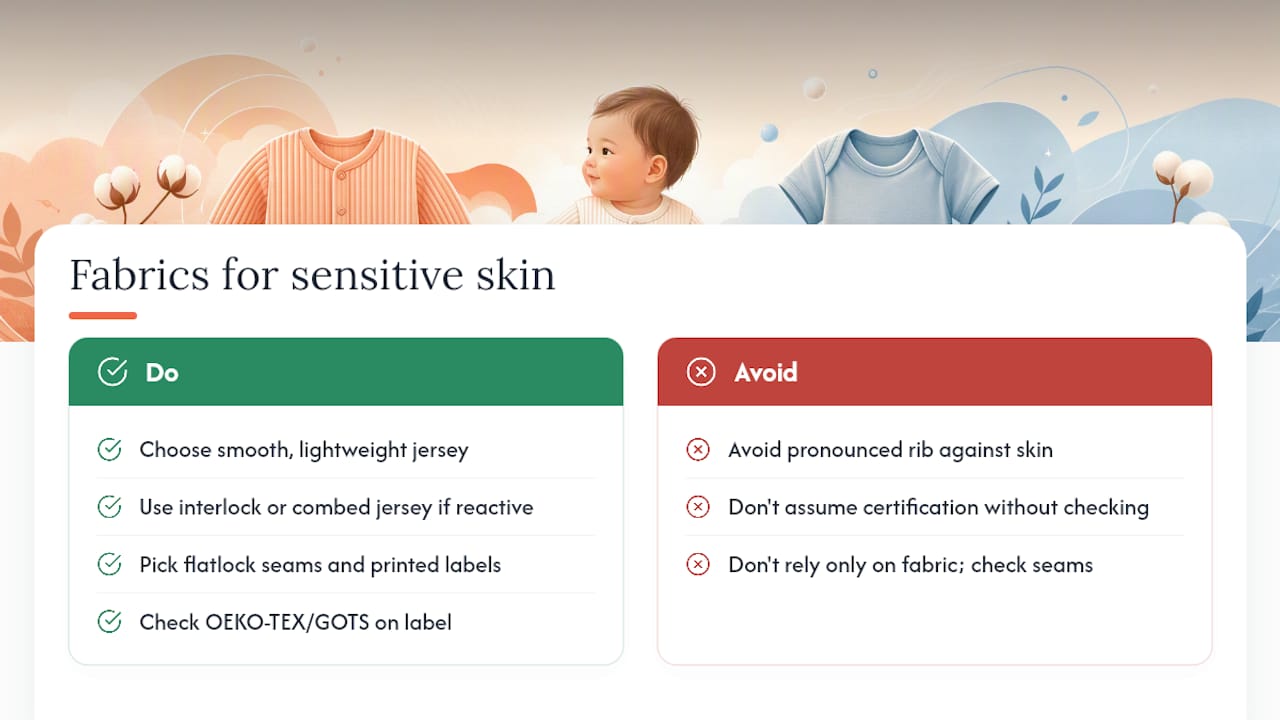
Jersey usually wins for everyday wear against sensitive skin because it’s flat, smooth, and low-friction. A newborn wriggling inside a bodysuit doesn’t need extra texture rubbing against delicate skin, and lightweight jersey lets air move rather than trapping heat close to the body.
Fine-gauge rib is still perfectly fine for cuffs and necklines, where only a small area touches the skin. But if you’ve got a baby who reacts to almost anything, interlock or a fine combed single jersey often feels gentler than a pronounced rib texture, since interlock is smooth on both sides rather than ridged.
Breathability follows the same weight logic as before: lighter single jersey suits warmer conditions, while heavier interlock or rib holds warmth better through cooler months. Neither one is “the” answer year round.
Beyond fibre choice, seams and labels are often the real irritation culprits, not the fabric itself. Flatlock seams and printed (rather than sewn-in) labels reduce rubbing significantly. When you’re comparing garments, check the tag and seam finish alongside the fabric type. Where a brand states OEKO-TEX Standard 100 or GOTS certification on the product listing, that’s a useful extra signal, though it’s worth confirming the claim directly on the label or brand page rather than assuming it applies across a whole range.
Which garments work best in each fabric?
Matching fabric to garment type saves you from buying something that looks lovely but fights against how babies actually move.
- Bodysuits and tees — single jersey is the standard here. It flexes with kicking legs and reaching arms without feeling restrictive, and it breathes well under other layers.
- Necklines, cuffs, and leggings — rib is the natural fit. Its extra stretch and strong recovery make pull-on necklines easier for dressing and mean waistbands and ankle cuffs stay snug rather than sagging by lunchtime.
- Pyjamas and rompers — interlock often edges ahead when you want opacity (no see-through fabric under nursery lighting) and a smooth surface for prints. Jersey’s flat face also prints well, but rib’s texture can distort a detailed pattern, so save bold prints for jersey or interlock rather than heavily ribbed pieces.
There’s also a practical “grow with me” angle. Rib’s stretch and recovery make it forgiving in leggings and fitted separates, giving a little extra room through growth spurts without the garment looking baggy the week after you buy it.
How should you wash and care for these fabrics?
Shrinkage in baby clothes usually comes down to heat, both from hot water and from the dryer, rather than the fibre type alone. Rib can shrink slightly in the wash yet still look sharp, because its recovery pulls it back into a neat shape even after some fibre contraction.
A few habits keep both fabrics performing well over time:
- Wash on a cool or gentle cycle with a mild detergent suited to baby skin.
- Skip high heat in the dryer, or air dry flat where possible.
- Reshape necklines, cuffs, and hems while the garment is still damp.
- Check seams and labels for rough edges before the first wear, not after a rash appears.
Pro Tip: Give a stretched neckline the “snap test” before you buy: gently pull it out and let go. If it springs back within a couple of seconds, recovery is solid. If it sags or takes its time, expect it to loosen with wear. Care habits like preshrinking and enzyme washing at the manufacturing stage also affect how a garment behaves after repeat washes, sometimes more than the fibre name on the label.
How do you choose between ribbed and jersey?
Run through this checklist before adding anything to your cart:
- Fibre content: 100% combed organic cotton is the gold standard for softness and durability.
- Certification claims: look for OEKO-TEX Standard 100 or GOTS mentions on the product page, and confirm details directly with the brand if it matters to you.
- Weight cues: GSM figures or simple “light” or “medium” descriptions tell you whether a piece suits summer or winter.
- Stretch content: a touch of elastane boosts recovery in leggings and fitted pieces, though 100% cotton rib already stretches well on its own.
- Seam style: flatlock or covered seams reduce rubbing against sensitive skin.
Typical stretch bands to keep in mind: standard jersey moves around 25 to 40%, while 1×1 rib can stretch to 150 to 200% of its resting width. Use those numbers as a rough gut check against any stretch claims a listing makes.
Rather than hunting for one “best” fabric, most well-built baby wardrobes mix constructions deliberately, jersey for basics, rib for trims, interlock for sleepwear and prints. Before you buy, ask yourself three quick questions: What will this garment actually be used for? Does the listing mention fibre content and finish? Does the seam style suit a wriggly baby who’ll wear this against bare skin?
How does Baby Goes Retro put this into practice?
Baby Goes Retro has been sourcing organic European baby wear since 2007, and the fabric mix across the range reflects everything above. Everyday basics lean on soft jersey bodysuits and tees, while fitted pieces and trims bring in rib for that extra stretch and recovery babies (and busy parents doing up snaps one-handed) actually need.
A few options worth a look: the Kite Pig Pannage Long Sleeve Bodysuit is a classic jersey-bodied everyday piece. The Kite Koala Time Baby Gift Bundle and Kite Little Goose Toddler Gift Bundle both mix jersey basics with rib-trimmed pieces, making them handy gift picks. The Kite Pear-fect Dungaree Toddler Bundle and Kite Koala Time Toddler Gift Bundle suit toddlers needing extra stretch through the waist and cuffs. For warmer days, the Kite Pear-fect Print Swimsuit shows off a bold print on a smooth knit base, and Slugs & Snails Drop Print Tights use a ribbed knit built for stretch through active little legs.
Every order ships flat rate for $7.95, or free once you spend over $97, with 30-day easy returns and exchanges if a fit or fabric doesn’t quite land.
A quick note from Daniel
My go-to combo is a jersey bodysuit under rib-trim leggings. It’s the pairing I’d reach for every time, smooth and breathable where it touches most skin, stretchy and secure at the ankles and waist where things need to move. If you’re shopping online, don’t skip the product Q&A. Ask about recovery after washing, since that tells you more about long-term fit than any marketing photo. It’s a small habit that saves you from a drawer full of saggy leggings by month three.
— Daniel
Where to find matching rib and jersey pieces
There are other places to buy baby basics, but few stock organic European jersey and rib pieces designed to be mixed and matched from the same trusted brands. Baby Goes Retro curates both fabric types across its collections, so you’re not guessing whether a jersey bodysuit will pair well with rib leggings from a different label.
Start with the organic baby bodysuits collection for smooth jersey basics, browse organic baby clothes for the full range including rib-trimmed rompers, or head to baby and kids basics for everyday staples that mix both. If you’d like some extra reading on choosing pieces that last through growth spurts, this guide on organic baby clothes that grow with your child is worth a look, and this piece on how stretch fabrics transform everyday wear explains recovery in more general terms if you want the fuller picture.
All orders ship for a flat $7.95, free over $97, with 30-day easy returns and exchanges if something’s not quite right. Add a jersey bodysuit and a pair of rib-trim leggings to your cart today and see the combination for yourself.
Sources
- The ultimate guide to natural knit fabrics: jersey, rib, interlock & beyond – Nature’s Fabrics
- Baby romper fabric guide: rib knit, interlock & muslin for infant wear
- Underwear & baby clothing fabric supplier — KARCEM
- Organic cotton fabrics for baby clothing: softness, safety and shrinkage to compare
FAQ
What type of fabric is best for baby clothes?
There’s no single best fabric. Combed organic cotton jersey suits everyday bodysuits and tees, while rib knit suits cuffs, necklines, and fitted pieces where stretch and recovery matter most.
What are the disadvantages of rib knit?
Rib knit can feel more textured against very sensitive skin than smooth jersey, and it’s usually less suited to detailed prints because the ridged surface can distort pattern registration.
Is ribbed knit the same as jersey knit?
No. Jersey is a single-direction knit with mostly horizontal stretch, while rib knit alternates raised and recessed columns that stretch in both directions and recover more strongly.
Is jersey fabric good for babies?
Yes, jersey is a strong everyday choice for babies because it’s lightweight, breathable, and smooth against skin, particularly in combed organic cotton versions like those Baby Goes Retro stocks for bodysuits and tees.
0 comments