


The quickest path to great sibling photos and easy everyday coordination is picking one shared visual idea, colour, print or theme, and then executing it across age-appropriate pieces rather than forcing identical outfits. Check fit and fastenings before you buy, since a gorgeous set that’s hard to change or too tight gets left in the drawer. Curated bundles can do the pairing work for you, giving parents a ready-made starting point across newborn to toddler sizes.
TL;DR:
- Matching bundles often come in sizes that suit both newborns and toddlers, making them practical for families with closely aged siblings.
- Durable, breathable fabrics like organic cotton are recommended for comfort, longevity, and ease of care, especially for active children.
- Ordering at least one to two weeks ahead ensures enough time for fitting, addressing sizing issues, and avoiding last-minute stress.
- Coordinating outfits should focus on shared colors or motifs with flexible garment types to allow individual preferences and confidence-building.
- Budget considerations include prioritizing versatile, repeated-use pieces over fully matching outfits, and buying in larger sizes to extend wearability.
Table of Contents
- What are the best ready-made matching sibling outfits to buy?
- Five practical coordinated looks to copy
- How do you choose the right size and fabric?
- What should you check before ordering online?
- How do you keep coordinated outfits comfortable on the day?
- What does matching sibling outfits usually cost?
- How long does it take to buy and receive matching outfits?
- How do you coordinate siblings with different styles or gender expressions?
- Coordination with choice builds real confidence
- Where to buy the featured bundles
- Sources
- FAQ
What are the best ready-made matching sibling outfits to buy?
Curated bundles solve the biggest headache in coordinated sibling clothing: matching pieces cut for wildly different body shapes without making anyone look like they’re wearing a costume. Some stores offer bundles built for exactly this problem, each aimed at a different stage of the sibling puzzle.
The Kite Little Goose Baby Gift Bundle is built around newborn and infant sizing, with soft organic cotton pieces in the Little Goose print running through a bodysuit, and coordinating accessories. It’s the standout pick for a new-baby gift set or for parents who want the youngest sibling’s look sorted first, then build the older kids’ outfits around that palette. The Kite Little Goose Baby Gift Bundle works well as a shower gift too, since it arrives essentially outfit-ready.
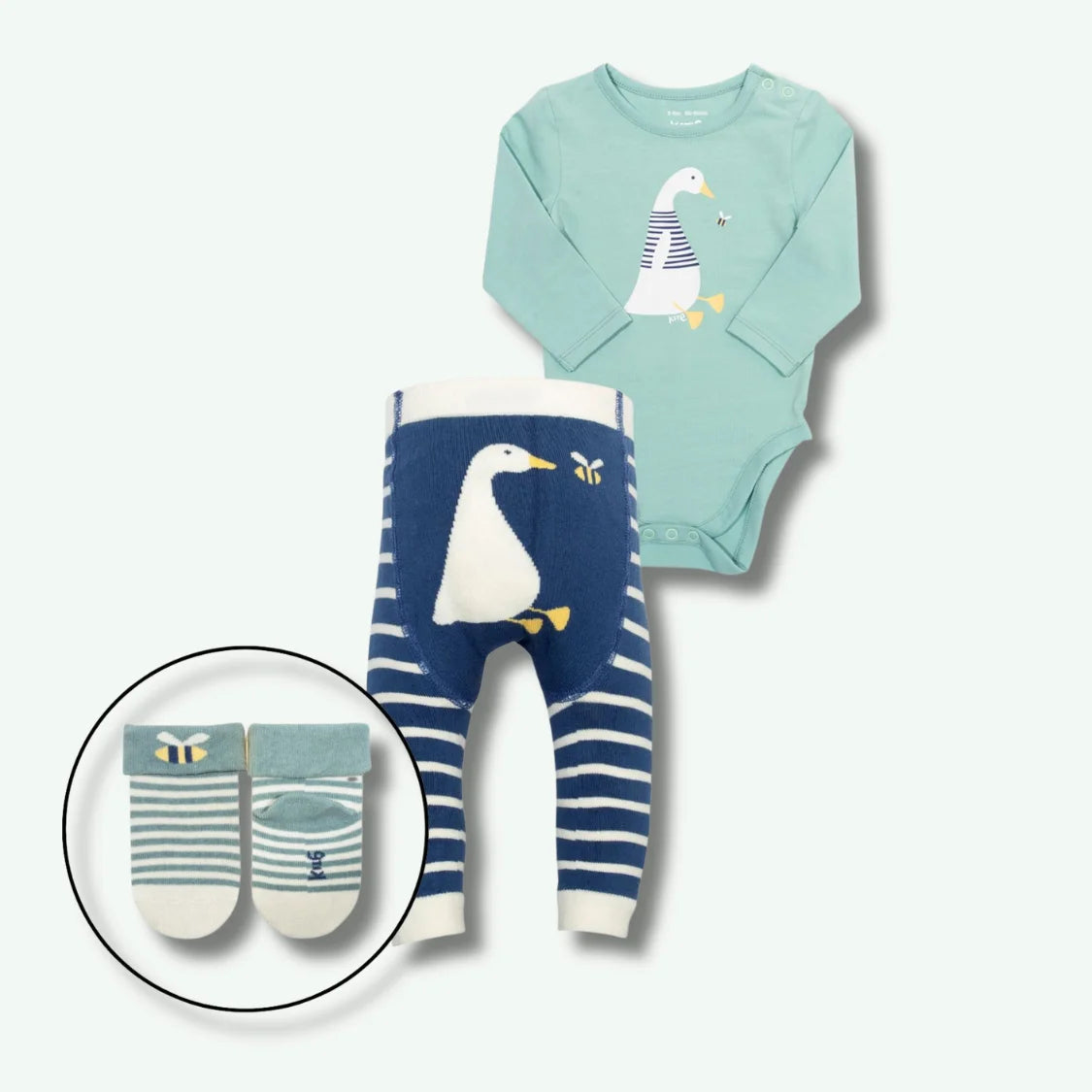
The Kite Little Goose Toddler Gift Bundle carries the same Little Goose motif into toddler sizing, with a dungaree-style piece and socks designed for a child who’s crawling, climbing and generally testing every seam. If your baby and toddler are close in age, pairing the Kite Little Goose Toddler Gift Bundle with the baby version gives you a matching motif across both ages without hunting for separate prints.
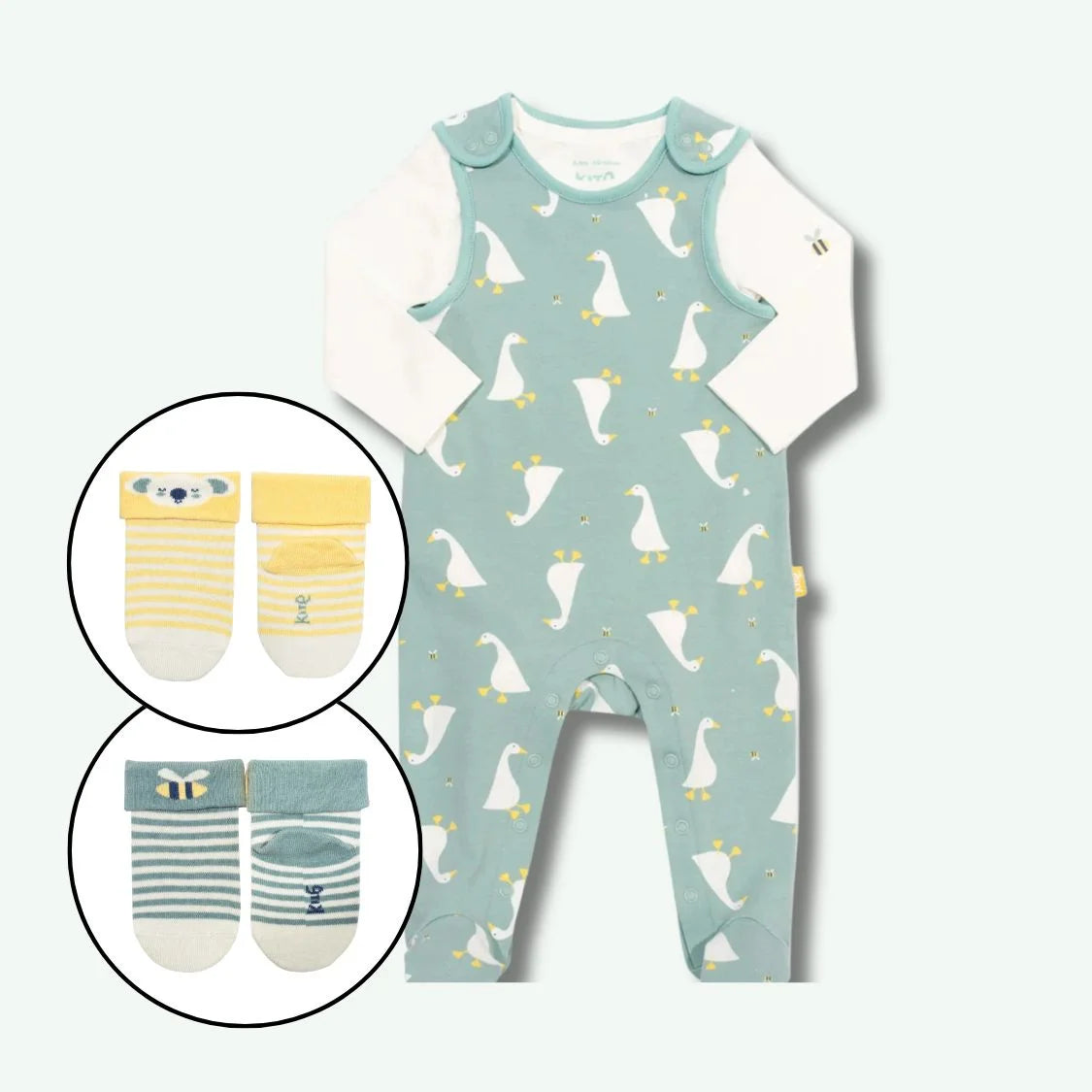
The Kite Pear-fect Dungaree Toddler Bundle trades the softer newborn fabrics for something tougher, a dungaree bundle built to survive actual play, not just a photo. It suits toddlers who are already hard on clothes, and it pairs neatly with a plain top on an older sibling to keep the whole group looking coordinated without matching stitch for stitch.
Mixing bundle pieces across siblings is simpler than it looks:
- Put the baby in the bodysuit from one bundle, dress the toddler in the matching dungaree, and let an older child wear a plain top or dress in the same colour family.
- Use one small accessory, socks, a hat, a hair tie, to tie a fourth or fifth sibling into the theme without buying a whole matching outfit.
- If a child is between sizes, always order the larger size rather than the smaller, since a tight garment shows up instantly in photos and won’t last the season.
Five practical coordinated looks to copy
You don’t need five different outfits to pull off five different looks. Small changes in cut and detail keep the concept coordinated instead of costume-like.
- Identical minis for photos. Same print, same colour, scaled down for the baby and up for the older sibling. Works best in soft organic cotton for short shoots, but it’s the hardest option to keep comfortable for a full day.
- Shared palette, different cuts. One colour scheme, different garment types, a romper for baby, shorts and a tee for the toddler, a dress for the older sibling. This is the easiest look to sustain past the camera.
- Statement print plus solids. Give the print to one child (often the smallest, since a whole outfit of loud print is easiest on a baby-sized garment) and echo just one solid colour from that print on the others.
- Denim anchor with shared tops. Put every sibling in denim bottoms, then match everyone in the same coloured top. Genuinely playproof, and cheap to repeat across seasons.
- Seasonal pyjamas set. A shared print in sleepwear works for family photos and sleepovers alike, and nobody has to be dressed up.
Pro Tip: Save the identical-minis look for the first ten minutes of an event, then let siblings change into the shared-palette version for the rest of the day. You get the picture-perfect shot without a meltdown by lunchtime.
For more concrete combinations, our Christmas matching sibling outfit ideas walk through exactly this approach season by season.
How do you choose the right size and fabric?
Sizing is where most coordinated sibling sets go wrong, mostly because parents shop by age label instead of by measurement. Measure each child’s chest and garment length, compare those numbers to the specific brand’s size chart, and choose the larger size whenever a child sits between two sizes. European sizing in particular can run differently to Australian charts, so check our EU vs AU kids sizes guide before you order multiple pieces from the same European label.
Fabric matters just as much as fit. Organic cotton and other soft, breathable materials sit better against sensitive skin than synthetic blends, and they tend to hold their colour and shape better wash after wash. Favour durable, easy-care fabrics for any outfit that’s going to see actual play, not just a photo session, since a set that only survives one wear isn’t much of a bargain even at a lower price.
Fastenings decide whether an outfit actually gets worn twice:
- For babies, look for press-studs down the front and a snap-crotch design, plus envelope necks that don’t need to be forced over a head.
- For toddlers learning to dress themselves, velcro tabs and larger buttons work better than tiny fasteners or back zips.
- For older siblings, standard buttons and zips are fine, but check seams sit flat rather than digging in when they’re seated in a car seat or highchair.
Our toddler size guide breaks this down stage by stage if you’re outfitting a toddler for the first time.
What should you check before ordering online?
Ordering several coordinated pieces at once raises the stakes if something arrives the wrong size or colour. Run through a short checklist before you check out:
- Measure both children and compare against the retailer’s own size chart, not a generic age guide.
- Read the care label before buying, especially if the set is going into regular wash cycles.
- Order a spare bodysuit or top if a baby is prone to feed-time spills, since changing outfits mid-shoot is common.
- Check the shipping cost and delivery window against your event date before committing.
In Australia, consumer guarantees apply automatically whenever you buy from a business, whether that’s in person or online. The ACCC’s guidance on repairs, replacements and refunds confirms that for a major fault, you can choose between a refund or a replacement, and the retailer must cover reasonable return postage on a confirmed faulty item. Keep your proof of purchase, since it’s the first thing any retailer or the ACCC will ask for. Store return windows sit on top of these guarantees rather than replacing them, so a shop’s 30 day policy and your statutory rights work together, not against each other.
How do you keep coordinated outfits comfortable on the day?
A set that looks perfect on a hanger can fall apart the moment kids start moving. Pack a spare practical layer for the baby, ideally something with easy nappy access, so a quick change doesn’t mean unpicking the whole outfit.
Before the actual event, test the full outfit in play, not just standing still for a photo. Watch how a toddler moves in a dungaree bundle or how an older sibling copes with a stiff collar for an hour. Choose easy slip-on shoes over anything with laces or buckles, and keep accessories minimal, since a hat or headband that needs constant readjusting shows up in every second photo.
For temperature swings, dress in layers you can add or remove without disturbing the coordinated look underneath, and keep a couple of safety pins and a spare hair elastic in your bag for quick fixes. Our newborn photo outfit ideas cover practical fastenings in more detail if the youngest sibling is only weeks old.
What does matching sibling outfits usually cost?
Prices for coordinated sibling sets vary widely depending on the number of pieces, the fabric, and whether you’re buying from a mainstream chain or an ethically produced European label. A single matching top can sit at the budget end, while a full multi-piece bundle covering two or three siblings sits at the higher end of the spectrum.
Budgeting for matching sibling outfits usually comes down to three decisions: how many children you’re dressing, how many outfits each child needs (one for photos, another for the actual event), and whether you’re buying pieces that will only get one wear or ones designed to be reused across seasons and handed down.
Buying separates in a shared palette, rather than a fully matching identical set, often stretches the budget further, since a plain top or bottom in the right colour can be reused in dozens of future outfits rather than sitting in a drawer as a one-off costume piece. Durable organic cotton pieces cost more upfront than synthetic fast-fashion alternatives, but they tend to survive multiple siblings and multiple seasons, which changes the actual cost-per-wear considerably. If budget is tight, focus your spend on the pieces that get worn most, tops and bottoms, and treat one-off accessories as the place to save.
How long does it take to buy and receive matching outfits?
Planning a coordinated sibling set for a specific date, a birthday, a family photo day, a holiday card, means working backwards from delivery time, not forwards from when you feel like shopping.
Most Australian online orders for baby and kids’ clothing take a few business days to process before dispatch, plus standard shipping transit time on top. If you’re ordering from multiple retailers to complete one look, build in a buffer for at least one delay, since coordinating several deliveries to arrive together is harder than ordering from a single source.
Give yourself at least one to two weeks before the actual event if you want time to try outfits on, discover a sizing issue, and reorder if something doesn’t fit. Leaving it to the last few days removes your safety net entirely, and a missing package the morning of a shoot is a stress no parent needs. If you’re using a scheduling or feed-tracking app like Naluna to plan around a baby’s nap and feed windows, build your outfit-change plan around the same schedule so the whole event runs smoother.
How do you coordinate siblings with different styles or gender expressions?
Matching doesn’t have to mean identical, and it shouldn’t mean forcing a child into a look that doesn’t feel like them. The most workable coordinated sibling clothing shares a colour palette or a single motif, then lets each child’s garment type reflect their own preferences, whether that’s a dress, shorts, dungarees or trousers.
If one sibling gravitates toward brighter colours and another prefers something quieter, pick a palette wide enough to hold both, two or three colours that complement each other rather than one single shade everyone has to wear. A statement print on one child and a solid pull-colour on another achieves the same coordinated effect without asking anyone to wear something they’ll fight you on.
For siblings of different genders, there’s no rule that says coordinated has to mean colour-coded by gender. A shared floral or novelty print works across a range of preferences, and neutral bases (denim, white, sage green) let you introduce brighter accents wherever each child is comfortable. Giving kids a say, even a small one, in which piece within the shared palette they wear tends to produce better photos anyway, since nobody’s fighting the outfit.
Our guide to building outfit combinations from one small capsule shows how a handful of coordinating pieces can flex across different personalities without anyone feeling forced into a costume.
Coordination with choice builds real confidence
Matching outfits work best as a framework, not a rulebook. Give a toddler two tops within the same palette and let them pick, and you’ll get a better photo than if you’d forced the “correct” one on them. Raising Children Network’s guidance on dressing backs this up: dressing decisions build a child’s independence, and offering choice within a shared palette avoids the meltdowns that come from insisting on identical clothing.
The approach of sourcing organic, ethically made European brands, often through family-run businesses, shows up in how bundles are put together, built for genuine wear, not just a single photo.
— Daniel
Where to buy the featured bundles
If you’ve landed on one of the three bundles above, here’s the quick version of who suits what. The Kite Little Goose Baby Gift Bundle is the pick for a newborn gift or the youngest sibling in a mixed-age set. The Kite Little Goose Toddler Gift Bundle matches that same print into toddler sizing, ideal when your baby and toddler are close in age. The Kite Pear-fect Dungaree Toddler Bundle is the tougher, playproof option for a toddler who’s already hard on their clothes.
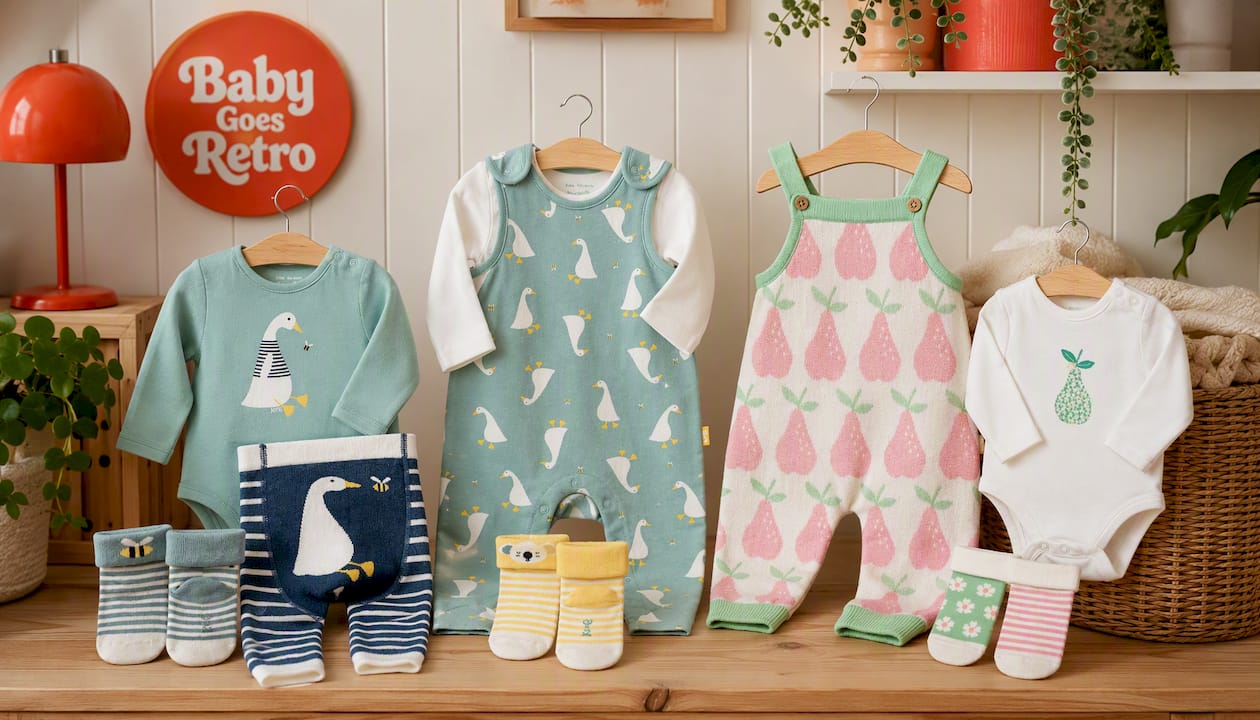
Baby Goes Retro is the alternative to hunting through five different stores trying to match prints by eye. Every bundle is picked as a set, in organic cotton, from ethically produced European brands, so the matching work is already done before it arrives. Shipping across Australia is a flat $7.95, free once your order passes $97, and every purchase comes with 30 day easy returns and exchanges if a size doesn’t work out. For older siblings, browse the kids tops, bottoms and dresses collection or the baby bodysuits and rompers collection to build out the rest of the look, then check the bundle pages above to lock in your sizes before your event date.
Sources
- How to buy the best baby clothes
- Problem with a product or service you sold — repair, replace, refund, cancel
- Getting dressed: helping children learn | Raising Children Network
FAQ
Where can I find matching sibling outfits in Australia?
Australian parents can find coordinated sibling clothing through specialist online stores like Baby Goes Retro, which curates ready-made bundles such as the Kite Little Goose Baby Gift Bundle, alongside mainstream retailers. Buying from a specialist store that groups pieces into a bundle usually saves time compared to matching individual items yourself.
Where can I buy matching sibling outfits?
You can buy pre-matched bundles designed for specific ages, such as the Kite Little Goose Toddler Gift Bundle, or build your own coordinated look by picking separates in one shared palette across different collections. Category pages for kids tops, bottoms and dresses make it easy to mix pieces once you’ve settled on a colour theme.
Are matching sibling outfits trendy?
Coordinated sibling clothing has remained a consistently popular choice for family photos and special occasions rather than a passing trend, and the current preference leans toward shared palettes and prints over strictly identical outfits. Parents increasingly favour a look that still lets each child’s personal style show through.
How do you choose matching sibling outfits?
Start with one shared visual idea, a colour, print or motif, then choose age-appropriate garment types for each child rather than forcing identical cuts. Measure each child individually, compare against the brand’s own size chart, and prioritise practical fastenings for babies so the outfit is easy to change on the day.
0 comments